
The decisions that close before the pour
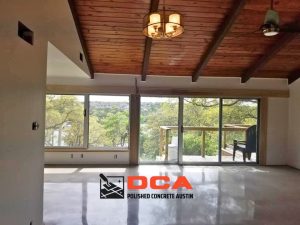
On a new build or a slab replacement, three things get settled before the concrete goes down, and none of them can be revisited afterwards.
Radiant heating. Pipes or mats go in before the pour, embedded in the slab itself. Concrete is exceptional for radiant heat, because the thermal mass that makes a slab slow to warm also makes it hold warmth for hours. Retrofitting isn’t realistic without removing the floor, so it’s genuinely now or never. If a cool floor underfoot worries you, this is the decision that solves it rather than any finish choice.
The vapour retarder. A membrane between the ground and the slab stops ground moisture entering the concrete. Older buildings often don’t have one, and nothing can be installed under a slab that already exists. It affects how the floor performs for its whole life.
The mix and the finish of the pour itself. A slab troweled very hard closes the surface up and takes considerably longer to open under a grinder. Aggregate size and distribution decide what a deep grind will look like. If you know polishing’s the plan, telling the concrete crew changes what they do, and it costs nothing to say.
Tell whoever’s pouring that the slab will become the floor. That one sentence is worth more than any decision you make later, and it costs nothing to say at the right moment.
Protecting a slab you intend to polish
Between the pour and the polish, a slab on a live site takes abuse. Most of it grinds out. Some of it doesn’t.
What grinds out: general dirt, most paint splashes, surface scuffing, footprints and light adhesive residue. None of that is worth worrying about, and trying to keep a working site spotless is not a reasonable goal.
What doesn’t, reliably: deep oil and hydraulic fluid from equipment, some chemical staining, gouges deeper than the grinding depth you’ve chosen, and anything that soaked in while the concrete was young and porous.
Young concrete is the vulnerable part. A slab in its first few weeks absorbs far more readily than the same slab a year later, so a spill during the build penetrates deeper than the identical spill would afterwards.
Covering the slab through the build costs less than dealing with any of it afterwards. Use breathable protection rather than plastic sheet, because trapped moisture under plastic creates its own problems on a young slab.
The worst damage we see comes from three sources: scaffold feet without pads, cutting tile or masonry directly on the slab, and equipment parked in one spot long enough to leak. All three are avoidable with a conversation at the start of the job rather than an apology at the end of it.
Where grinding fits in a renovation
Late in the programme, but not last, and the distinction matters more than it sounds.
Polishing is dusty, loud and needs the room completely empty. It also produces a finished surface that every trade coming after it can damage. Those two facts pull against each other, which is why the sequence matters.
The order that works: demolition, then any structural or plumbing work that opens the slab, then the messy trades, then polishing, then cabinets and fixtures, then paint touch-ups, then you move in.
Painting is the one people get wrong most often. Paint splashes on a raw slab grind out. Paint splashes on a finished polished floor come off with care, but the care takes longer than masking would have.
The order that causes problems: polishing early because the room happens to be empty, then running six more weeks of trades across a finished floor. We’ve been called back for that more than once.
There’s a middle position worth knowing about on larger projects. The grinding stages can be done early and the final polishing and sealing left until the end, which protects the finish while getting the disruptive part out of the way. It costs a second mobilisation, so it makes sense on big floors and not on a single room.
Before or after cabinets
Before the cabinets go in, in almost every case, and the reason is edges.
Grinding around installed cabinets means edge work in tight spaces, and the finish along those edges is never quite the same as the open floor. The machines can’t reach the last few inches, so you end up with a visible boundary you didn’t choose.
Polishing first gives you a continuous floor and lets the cabinets sit on it. The trade-off is that the floor’s finished while the kitchen is still being fitted, so plan to keep it covered a few weeks.
The exception is a kitchen where the cabinets are already in and staying. Then we work around them, and we’ll tell you at the assessment where that edge line falls so it isn’t a surprise later.
The same logic applies to anything fixed to the floor. Islands, built-in seating, partition walls that stop short of the ceiling. If it’s going in and it’s staying, polishing before it arrives gives a better result than polishing around it afterwards.
New builds and the curing question
A new slab isn’t ready immediately, and the reason is moisture rather than strength.
Concrete keeps releasing moisture for months after pouring. That affects which sealer performs and how the floor behaves years later, which is why the slab reading sets your date rather than the calendar.
The practical effect on a build programme is that polishing may need to sit later than planned. An unready slab becomes ready with time, so the answer is a date rather than a product. If your handover date is fixed and the reading comes back high, that conversation needs having early rather than the week before.
What we’d suggest on any new build: test the slab as soon as the building is closed in, well before the floor is due. That gives you a reading early enough to plan around rather than a problem discovered at the end. Testing costs a few days and finding out late costs weeks.
Renovations of older houses
Old houses bring the opposite problem. Their slabs are dry and settled, which helps enormously, and they’ve been through decades of other people’s decisions, which doesn’t help at all.
Additions are the sequencing issue here. Where a room was extended at some point, concrete poured decades apart meets somewhere in the middle of the floor, and the two sides grind differently. If you’re planning an extension and a polish, that seam is worth designing around rather than discovering. Putting it under a threshold or a piece of furniture is a decision available at the drawing stage and nowhere after it.
Slab penetrations matter too. Any plumbing or electrical work that cuts the slab has to be finished and patched before grinding, because a patch cut afterwards will never match. Get it all done first, even the work you were planning to defer.
That includes the work you’re only half considering. A future kitchen island with a power supply, an outdoor tap through the wall, a bathroom you might move in five years. If any of it involves opening the floor, opening it before the polish is cheaper by a wide margin.
What to tell your builder or architect
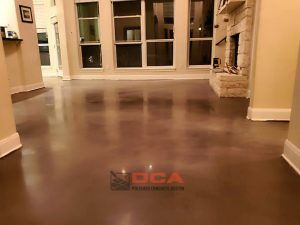
Four things, and the earlier you say them the more they’re worth.
That the slab will be the finished floor. It changes how the concrete gets poured, how it gets protected, and how everyone on site treats it for the next several months.
Whether radiant heating is wanted. That’s before the pour or not at all, and it’s the decision people most often wish they’d made.
That polishing needs the space empty and the trades sequenced around it. It’s a few days, not a few hours, and it can’t share the room with anyone.
That the floor gets protected between polishing and handover. Most of the damage we’re called back to look at happens in exactly that window, when the floor is finished and the building around it still isn’t.
There’s more on what to ask a contractor, and on which cost variables are decided by the slab rather than by you.
One last thing worth saying to anyone at the planning stage. Polishing is the only floor finish where the material is already paid for and already in the building. That changes the calculation on a renovation, because you are choosing whether to uncover something you own rather than choosing what to buy.
Established 2012, working across Austin and Central Texas. Fully insured, no subcontractors, and estimates are free.
Call (512) 900-5938 or request an estimate, and we’ll tell you where polishing fits your programme.