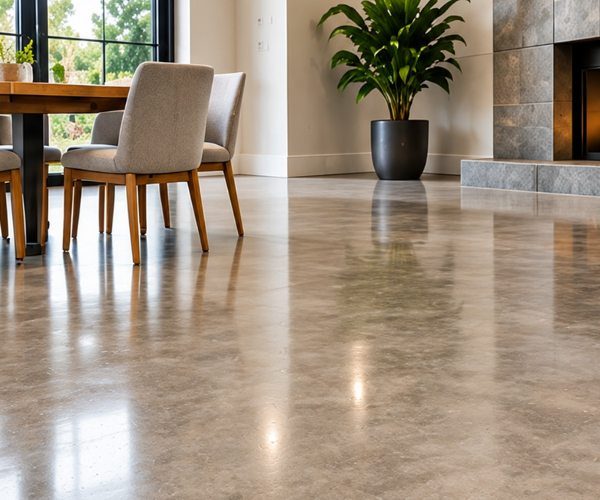
Polished Concrete Georgetown, TX
Polished concrete in Georgetown is the slab already under your house, worked through diamond grit stages and hardened with a lithium densifier into the finished floor. Nothing gets added on top of it, and nothing needs replacing later.
Request A FREE Quote
There’s no coating to peel later, which is the argument for refining a slab rather than covering it. Someone looks at the floor before we price it, at no charge, because what decides the work is the slab rather than the square footage.
Georgetown splits into two kinds of job and they’re barely related. North and west of the centre, single-storey retirement housing where the owner wants a floor that doesn’t need looking after. In and around the historic districts, older properties where the slab has decades of history in it, and polishing brings all of it up.
Whole-house work is most of what we do either way. Living rooms, kitchens, hallways where the carpet is coming up and the concrete underneath is sound. Garages are the other half, usually where a coating has started peeling at the door.
What polishing won’t do is hide the slab. It shows what’s underneath, so we say what will come out and what won’t before we start.
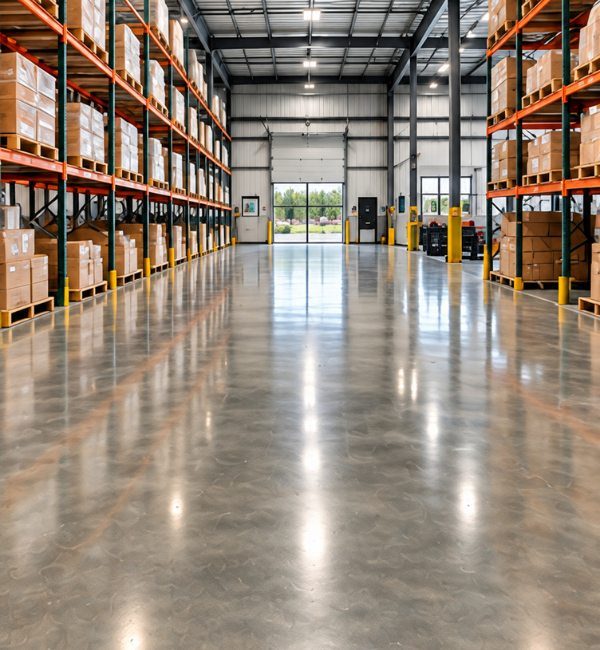
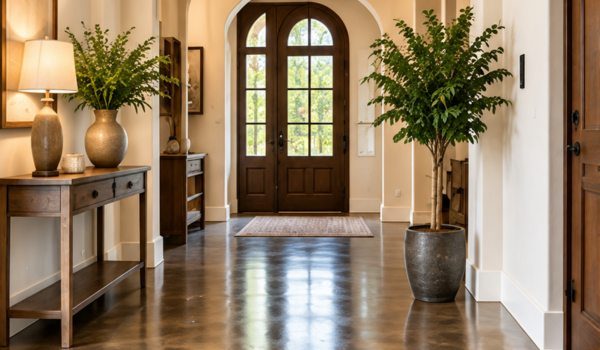
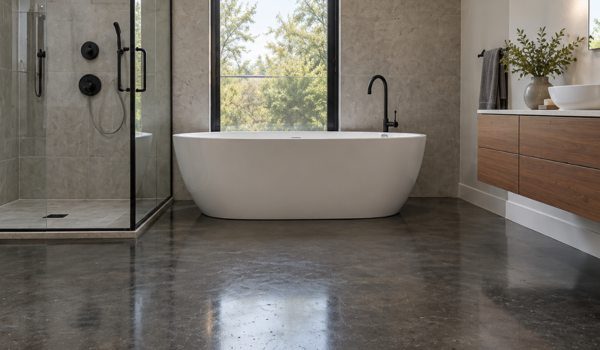
What we find on Georgetown slabs
Georgetown is the Williamson County seat, twenty-five miles north of Austin, and it has the widest spread of building ages of any city we serve.
The downtown around the courthouse square is the best-preserved Victorian commercial district in Texas, with three National Register historic districts and more than 180 historic buildings. Those and the surrounding Old Town streets sit under a design overlay, so any work there has constraints that don’t apply elsewhere. The slabs in that area are usually later additions to much older buildings, and they behave accordingly: multiple pours, patched repairs, and levels that don’t quite match between rooms.
Sun City and the newer developments north and west are the opposite case entirely. Those are single-storey slab-on-grade builds from the late nineties onward, laid on prepared sites to a consistent spec. They grind evenly and quote predictably, and they’re some of the most straightforward floors we take on anywhere in the metro.
There’s a practical reason polished concrete suits that housing particularly well. A floor with no thresholds, no grout lines and nothing to catch a walker or a wheelchair on is easier to live with, and it needs no maintenance beyond sweeping. For an owner who doesn’t want a floor to be a job, that matters more than the finish level does.
The city has grown from about 79,000 residents in 2019 to over 100,000, so there’s a third category arriving: new builds where the slab is still curing when we’re asked about it.
How the work runs
Assessment. We check hardness, flatness, cracking, coating history and whether moisture is still moving up through the concrete. On a new Georgetown build the moisture question matters most. In an older property near the square it’s the pour history.
Preparation. Old coatings, adhesive, paint and tile thinset come off mechanically rather than with solvents. Settled cracks and spalled areas get filled with color-matched material so they read as part of the floor rather than as obvious repairs. Tack-strip holes around the perimeter get filled too, and on a house that has had carpet for twenty years there are plenty of them.
Grinding. Coarse diamond tooling opens the surface and flattens high spots. This is the dusty stage, and we run vacuum extraction throughout while sealing off rooms we aren’t working in so the house stays usable.
What we watch for is how evenly the slab opens. On a Sun City build it opens consistently across the whole footprint. In a converted or extended older property it rarely does, because a second pour grinds differently from the original.
Densifying. Lithium densifier reacts with free lime inside the concrete and hardens the slab from within. That’s what makes the floor abrasion resistant rather than merely smooth, and in a garage it’s what resists hot tyre marking.
Polishing. Progressively finer grit stages take the surface to the sheen you chose. Matte hides dust and suits garages and workshops. Satin sits in the middle and works through most of a house. A high gloss finish carries light across an open room and shows every footprint with it.
Grinding depth is a separate decision from sheen. Stop shallow for a cream finish with little stone showing, or go deeper and the aggregate appears. We bring samples so you’re choosing from something you can hold.
Sealing. A penetrating sealer guards against oil and water staining. It soaks into the concrete rather than sitting on top, so there’s nothing to wear through or reapply on a schedule.
Anti-slip treatment is available where a floor gets wet or someone wants extra grip underfoot. It changes how the surface feels rather than how it looks, and on a single-storey home it’s worth asking about at the assessment.
A single garage runs one to two days from first grind to final seal. A whole ground floor takes longer, and we’ll give you a realistic window rather than an optimistic one.
Why Georgetown homeowners work with us
We only polish. Not coatings, not overlays, not staining. That narrowness is the point: the person quoting your floor has ground several hundred slabs rather than a handful between other trades.
We assess before we quote, and estimates are free. Nobody prices a floor accurately over the phone, because the condition of the slab decides the timeline far more than the square footage ever does.
We’re straight about what a floor will give you. An older property near the square may not polish to a uniform finish across a room, and you’ll hear that at the assessment rather than after the grinders have run.
Georgetown is about thirty miles north of us, so we schedule work there in blocks where we can. It’s worth asking when we’re next heading that way rather than assuming a smaller floor isn’t worth the trip.
We won’t oversell a finish either. High gloss looks striking in a photograph and shows every footprint in a hallway, which is worth thinking about before committing rather than afterwards.
Established 2012, more than 1,000 floors completed across Central Texas. Fully insured. We hold no certifications we can’t show you and name no trade bodies we don’t belong to.
Frequently asked questions
How much does polished concrete in Georgetown cost?
Georgetown quotes split the same way the housing does. A single-storey slab north of the centre is straightforward, laid flat to one spec, and prices accordingly. An older property near the square with three pours and mismatched levels needs more assessment and more preparation. We will tell you which yours is before quoting, and that visit costs nothing.
Is a polished floor a good choice for a single-storey home?
Often, yes. There are no thresholds between rooms, no grout lines and nothing raised to catch a foot, a walker or a wheelchair wheel. Maintenance is a dust mop and a neutral cleaner, with no waxing or resealing cycle to keep up with. For an owner who wants a floor that isn’t a job, it’s a strong fit.
Can you polish a slab in an older property near the square?
Usually, though we’d want to see it first. Older buildings there have generally been added to over decades, which means more than one pour and an uneven grind. Polishing doesn’t hide that. It can read as character once it’s finished, but you should see what to expect before committing rather than after.
Which parts of Georgetown are hardest to polish?
Older properties in and around the historic districts. Those buildings have generally been added to across a century, so a single room can sit on two or three pours with different aggregate and slightly different levels. Polishing brings all of that up rather than hiding it. It can look excellent, but you should see samples before deciding.
What about the garage?
Same process on a smaller slab, and it’s often what prompts the call. A garage coating that’s lifting at the door edge can be ground back to bare concrete and polished, and that’s preparation rather than a separate job. A densified slab also resists hot tyre marking, which is what usually ruins a coated garage floor.
Does the historic overlay affect what we can do?
For interior floors, generally not. The downtown and Old Town design guidelines govern exteriors and street-facing work rather than what happens inside. If your property carries a historic designation it’s worth checking with the city before any work, but polishing an existing interior slab isn’t the kind of change those rules are written for.
Book a free estimate
Based in Austin, Texas, working throughout Georgetown and Williamson County. Open Monday to Friday, 7:00 AM to 6:00 PM.
Call (512) 900-5938 or request an estimate and we’ll arrange a time to look at the floor.