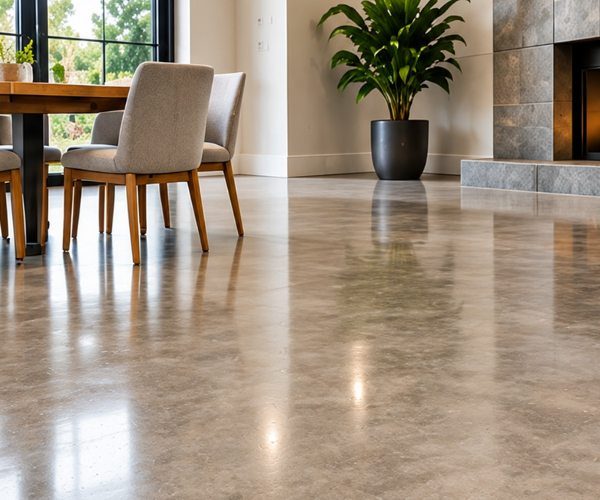
Polished Concrete Round Rock, TX
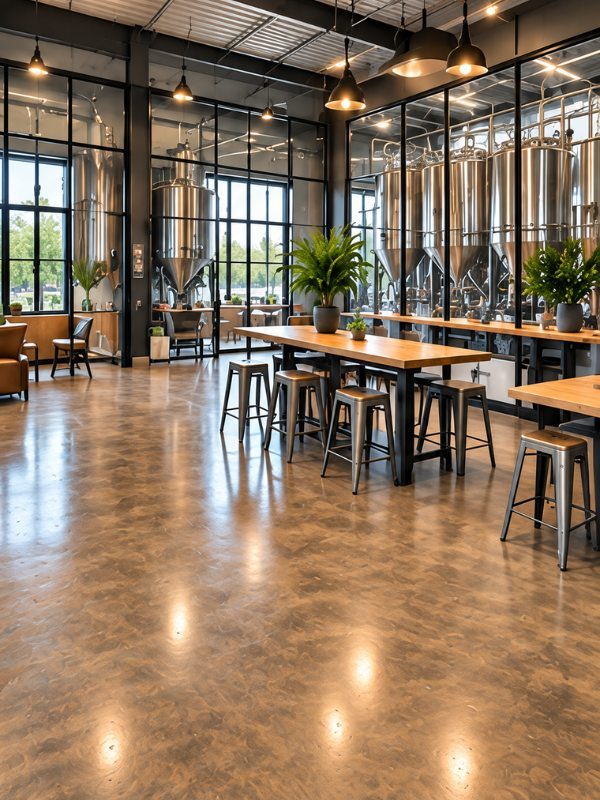
Polished concrete in Round Rock starts with the slab already in your building, ground through diamond grit stages and hardened into the finished floor. Nothing is applied over the top of it. We work across Round Rock and the surrounding area.
Request A FREE Quote
Round Rock sits about twenty miles north of us, which for a floor crew is close enough that a single-garage job is as workable as a warehouse. We’re there often enough that scheduling rarely holds a job up.
Every quote begins with someone standing on your slab, and that visit costs nothing. What we’re looking for is the condition of the surface, not the square footage, because that’s what decides the timeline.
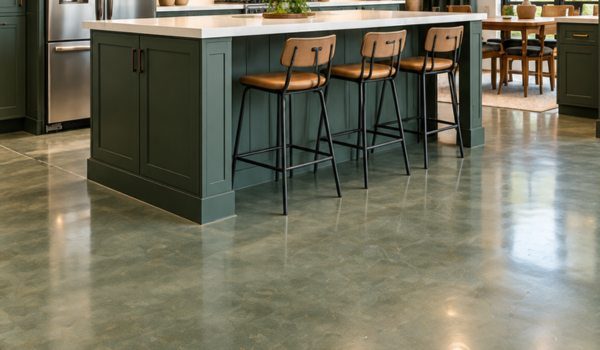
It suits homeowners who have pulled up carpet and found bare concrete underneath. Businesses fitting out retail along the I-35 corridor.
And anyone who has looked at what a coated garage floor costs to renew. A polished floor has no coating on it to lift or peel.
What it doesn’t do is hide the slab. A polished floor shows what’s underneath, including old patches and previous repairs. We’d rather tell you what will come out and what won’t before we start than have you find out on day two.
What we find on Round Rock slabs
Round Rock sits in Williamson County rather than Travis, and it splits into three delivery zips that behave differently under a grinder.
78664 covers the original downtown around Old Main Street, and those slabs are the oldest in the city. They behave like central Austin: additions, converted garages, more than one pour meeting in the middle of a room. Polishing reveals all of it, so we walk those floors carefully before quoting.
78681 and 78665 cover the growth. Teravista, Forest Creek and the Brushy Creek corridor were built out through the nineties and 2000s, and those slabs are the easiest in the city to work with. Consistent mix, flat, poured to a spec, and free of the patchwork you find in an older house that’s been extended twice. They grind predictably and they quote predictably.
What varies more in those neighbourhoods is what sits on top. Garages here are frequently coated, because a coated garage floor is what gets sold to a new-build owner, and a decade of Texas summers later it’s lifting at the door edge. Stripping that back is the single thing most likely to move a Round Rock quote once we’ve seen the floor.
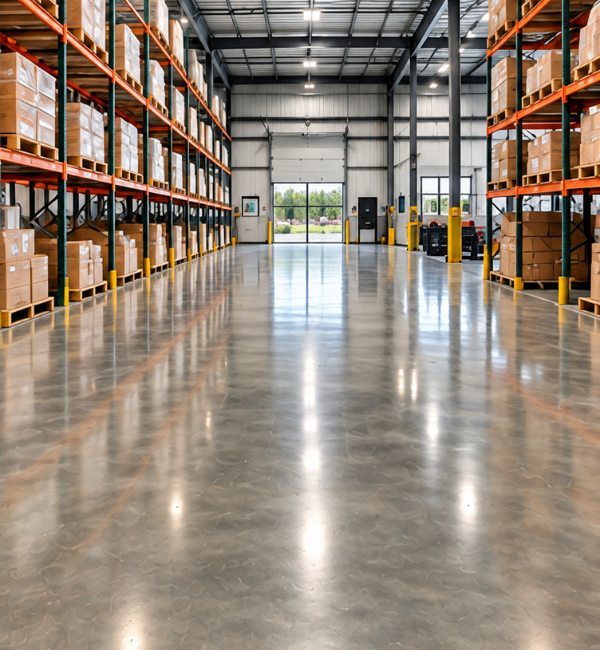
The commercial picture is different again. The I-35 and SH-45 corridors and the Dell campus area in 78682 carry warehouse and office slabs laid to tighter tolerances than anything residential. Those make good polishing candidates. The variables are coating history and how the control joints have held up under traffic.
How the work runs
Assessment. We check the slab’s hardness, flatness, moisture movement, cracking and coating history. On a Round Rock job the coating history usually matters most, because it decides how much of the timeline goes on preparation rather than on polishing.
Preparation. Old coatings, adhesive and paint come off mechanically rather than with solvents. Cracks and spalled areas are filled with color-matched material so they read as part of the floor instead of as obvious repairs. Control joints get filled where the floor carries vehicle or forklift traffic, because an unfilled joint edge chips under hard wheels.
Grinding. Coarse diamond tooling opens the surface and flattens high spots. This is the dusty stage, and we run vacuum extraction throughout. In a house we seal off adjoining rooms first. In a garage the door usually gives us enough ventilation to work faster.
What we watch for here is how evenly the slab opens. On a newer Round Rock pour it usually opens consistently, which is the main reason these floors are predictable to quote. Where a room has been added or converted, it opens unevenly, and that changes what we can promise about a uniform finish.
Densifying. Lithium densifier reacts with free lime inside the concrete and hardens the slab from within. That’s what makes the floor abrasion resistant rather than just smooth, and on a garage slab it’s what resists hot tyre marking.
Polishing. Progressively finer grit stages take the surface to the sheen you chose. Matte hides dust and tyre marks, which suits garages and workshops. Satin sits in the middle and works in most homes. High gloss carries light across an open floor and shows every footprint with it.
Grinding depth is a separate decision from sheen. Stop shallow for a cream finish with little stone showing. Go deeper and the aggregate appears, up to a fully exposed stone surface. How far we can reasonably go depends on what sits near the surface of your particular slab, so we bring samples rather than photographs.
Sealing. A penetrating sealer guards against oil and water staining. It soaks into the concrete rather than forming a layer on top, so there’s nothing on the surface to wear through where the traffic concentrates, and nothing to reapply on a schedule.
Most residential jobs run a few days. Larger commercial slabs take longer, and we’ll give you a realistic window rather than an optimistic one.
Why Round Rock customers work with us
We only polish. Not coatings, not overlays, not staining. On a garage floor that matters more than most rooms, because a failed coating is usually what prompted the call in the first place.
We assess before we quote, and estimates are free. Nobody prices a floor accurately over the phone, because the condition of the slab decides the timeline far more than the square footage does.
We’re straight about what will come out. Oil that’s sat in a slab for years sometimes stays visible after polishing, and no amount of grinding changes that. You’ll hear it at the assessment rather than three days in, when the garage is already empty and the equipment is on site.
Being twenty miles out means we schedule Round Rock work in blocks where we can, so a smaller job doesn’t sit waiting weeks for a slot. It’s worth asking when we’re next heading up that way rather than assuming a single garage isn’t worth the trip.
Established 2012, with more than 1,000 completed projects across Central Texas, a good share of them north of the river. Fully insured. We hold no certifications we can’t show you and name no trade bodies we don’t belong to.
Frequently asked questions
How much does polished concrete cost in Round Rock?
Square footage sets the floor, but preparation sets the price. In Round Rock the usual variable is coating removal, because so many garages here were sold with one and it is now lifting. Grinding that back to bare concrete before any polishing starts can add a day or more. A bare slab in reasonable condition moves far quicker. Estimates are free and start with someone walking the floor.
Do you charge more because we're outside Austin?
No. Round Rock is twenty miles up the I-35 and we work there regularly, so travel doesn’t change the quote. What changes it is the slab. A large commercial floor further out is often more workable than a small job nearby, and we schedule Round Rock jobs in blocks where possible so a smaller floor isn’t waiting weeks for a slot.
Can you polish a garage floor that was coated?
We can’t polish over one, but taking it off is routine work here. Round Rock garages built through the nineties and 2000s were very often sold with a coating, and most of those are now at the end of their life. Grinding it back is preparation rather than a separate job, and what is underneath is usually sound.
Will a polished floor handle a covered patio?
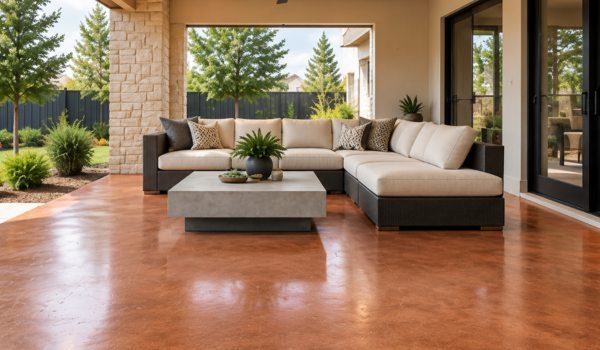
A covered patio, yes. The slab needs to be genuinely sheltered rather than open to weather, and the finish level matters more outdoors than in, because a high gloss surface gets slippery when it’s wet. We’d usually recommend matte or satin with an anti-slip treatment for anything that gets rained on sideways.
How do I keep a polished floor clean?
A dust mop for grit and a pH-neutral cleaner with a damp mop for anything wet. That’s the whole routine. Avoid vinegar, bleach and anything strongly alkaline, all of which dull the finish over time. No waxing, no stripping and no resealing schedule, because there’s no coating on the surface to renew.
What if my slab has cracks?
Surface cracks get filled with color-matched material and become part of the floor. Cracks that are still moving are a different problem, because filling them before the movement stops just means filling them twice. We look for the difference at the assessment and tell you plainly which kind you have before anything is committed.
Book a free estimate
Based in Austin, Texas, working across Round Rock and Central Texas. Open Monday to Friday, 7:00 AM to 6:00 PM.
Call (512) 900-5938 or request an estimate and we’ll arrange a time to walk the slab with you.