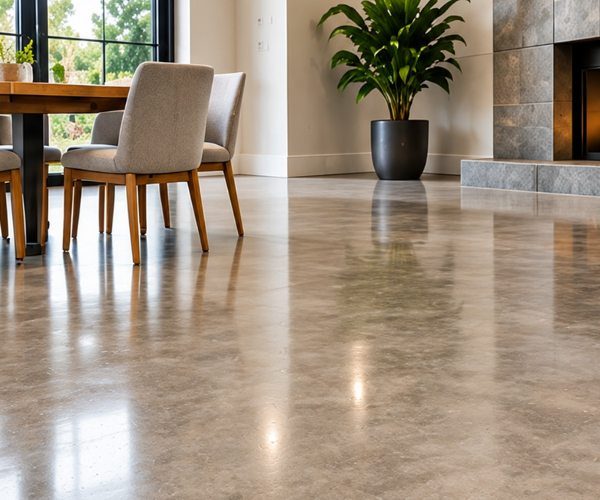
Polished Concrete Pflugerville, TX
Polished concrete in Pflugerville is the slab already under your house, ground through grit stages into the finished floor and hardened with a densifier. Nothing is added on top.
Request A FREE Quote
Nothing sits on top waiting to fail, which is the whole argument against covering a slab rather than refining it. Someone stands on the floor before we price it, at no charge.
Most of the housing here went up between the mid-nineties and the late 2000s, and that’s the sweet spot for polishing. Those slabs were poured to a decent spec, they’ve had time to settle, and the flooring over them is now old enough to be coming up anyway.
On a house of this age what we’re reading is the crack pattern, plus whatever the last flooring left behind.
Whole-house work is the bulk of what we do in Pflugerville. Living rooms, kitchens, hallways, usually where the original builder’s carpet or tile has done its twenty years and the concrete underneath is sound.
Garages are the other half, and they nearly always arrive the same way: a coating applied at some point in the last decade that has started peeling at the door edge.
What polishing won’t do is hide the slab. It shows what’s underneath, so we tell you what will come out and what won’t before we start rather than after the grinders are running.


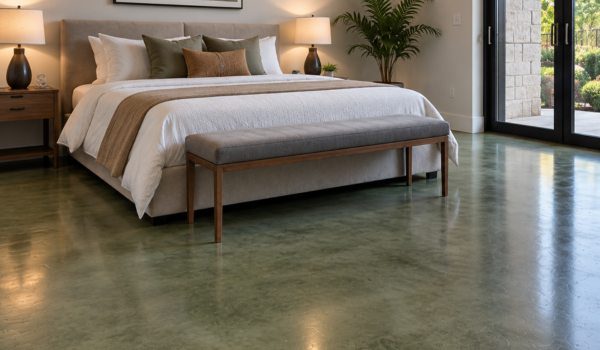
What we find on Pflugerville slabs
Pflugerville sits in northeastern Travis County, about fifteen miles north of Austin, with a small northern edge crossing into Williamson. It’s on the same Blackland prairie belt as Hutto, so the soil is expansive clay and slabs move seasonally with it.
The housing story is different from anywhere else we work. Pflugerville was a German farming settlement from 1849 and stayed small for well over a century. It only incorporated in 1965, and as recently as the mid-nineties the population was just over 5,000. Today it’s around 65,000.
That means almost all the residential stock was poured in a twenty-year window between the mid-nineties and the late 2000s. It’s the classic late-century tract slab: poured to a consistent spec, laid on prepared sites, and now twenty to thirty years old.
That age is an advantage. The slab has finished the settlement movement a new pour still has ahead of it, so cracks that were going to appear have generally appeared and settled. What we look for is whether they’ve stopped moving, because a settled crack fills and becomes part of the floor while a live one reopens.
The older exception is the East Main Street historic district and the handful of surviving farm properties east toward New Sweden and Wilbarger Creek. Those behave like any long-lived building, with additions and second pours meeting somewhere in a room.
How the work runs
Assessment. We check hardness, flatness, cracking, coating history and whether moisture is still moving through the slab. On a Pflugerville floor the crack pattern is the main question, because the clay underneath means most slabs here have some.
That’s also the part of a quote most likely to change once we’ve seen the floor, which is why we won’t price this city over the phone.
Preparation. Old coatings, adhesive, paint and tile thinset come off mechanically rather than with solvents. Settled cracks and spalled areas get filled with color-matched material so they read as part of the floor rather than as obvious repairs. Tack-strip holes around the perimeter get filled too, and on a house of this age there are usually plenty.
Grinding. Coarse diamond tooling opens the surface and flattens high spots. This is the dusty stage, and we run vacuum extraction throughout while sealing off rooms we aren’t working in so the house stays usable.
What we watch for is how evenly the slab opens. On a nineties or 2000s tract build it usually opens consistently across the whole footprint, which is why these floors are straightforward to quote. Where a room has been added since, it opens unevenly.
Densifying. Lithium densifier reacts with free lime inside the concrete and hardens the slab from within. That’s what makes the floor abrasion resistant rather than merely smooth, and in a garage it’s what resists hot tyre marking.
Polishing. Progressively finer grit stages take the surface to the sheen you chose. Matte hides dust and suits garages and workshops. Satin sits in the middle and works through most of a house. High gloss lifts an open-plan room and shows every footprint with it.
Grinding depth is a separate decision from sheen. Stop shallow for a cream finish with little stone showing, or go deeper and the aggregate appears. We bring samples so you’re choosing from something you can hold.
Sealing. A penetrating sealer guards against oil and water staining. It soaks into the concrete rather than sitting on top, so there’s nothing on the surface to wear through or reapply on a schedule.
Anti-slip treatment is available where a floor slopes toward a door or a garage doubles as a workshop. It changes how the surface feels underfoot rather than how it looks.
A single garage runs one to two days. A whole ground floor takes longer, and we’ll give you a realistic window rather than an optimistic one.
Why Pflugerville homeowners work with us
We only polish. Not coatings, not overlays, not staining. On a slab that moves seasonally with clay underneath, adding a layer on top is the arrangement most likely to fail, and it usually fails visibly.
We assess before we quote, and estimates are free. Nobody prices a floor accurately over the phone, because the crack pattern and the coating history decide the work rather than the square footage.
We’re straight about limitations. If a crack is still moving we’ll say it needs to settle before filling is worth doing, even though that means waiting rather than taking the booking.
Pflugerville is about twenty miles from us, so we schedule work there in blocks where we can. It’s worth asking when we’re next heading that way rather than assuming a smaller floor isn’t worth the trip.
A nineties tract house is one of the more predictable floors we take on, and that’s worth saying plainly rather than dressing it up. The work is straightforward here more often than it isn’t.
Polishing floors across Central Texas since 2012, more than 1,000 of them. Fully insured. We hold no certifications we can’t show you and name no trade bodies we don’t belong to.

Frequently asked questions
How much does polished concrete in Pflugerville cost?
What decides it here is what has been laid over the slab since the house went up. Twenty-five years usually means carpet, tack strip and sometimes a tiled kitchen on top, and all of it comes off before anything else happens. Houses of this age are fairly consistent, so quotes here are more predictable than in older parts of the metro. Estimates are free.
My house is from the nineties. Is the slab too old?
No, and if anything the age helps. A slab that’s been down twenty-five years has finished the settlement movement a new pour still has ahead of it, so what cracks were going to appear have generally appeared. We check whether they’ve stopped moving, then fill the settled ones and get on with it.
What's under the carpet in a house this age?
Usually tack-strip holes around every perimeter, carpet adhesive, and sometimes tile thinset where a kitchen or bathroom was redone at some point. Occasionally a layer of self-levelling compound. None of it rules out polishing. It all comes off mechanically, and it’s the main thing that decides how long the preparation stage runs.
The builder coated our garage. Can that come off?
Yes, and on a house of this age the coating is often the second thing to go down rather than the first. Taking it back to bare concrete is preparation rather than a separate job. How long it adds depends on what it was and how well it stuck, which is not something anyone can judge from a photograph.
Will the floor crack again after it's polished?
The slab can move again, because clay soil does that seasonally. What changes is what happens when it does. A polished surface is the concrete, so a hairline that opens stays a hairline in the floor. A coating on top would split and lift instead, which is why coated floors around here show trouble long before the concrete itself does.
Can the finish be made less slippery?
Yes, and it’s worth asking at the assessment rather than afterwards. A polished surface already has more traction than sealed tile, because the finish comes from the density of the concrete rather than a film on top. Where a floor gets wet regularly, or a garage doubles as a workshop, an anti-slip treatment changes the feel underfoot without changing the look.
Book a free estimate
Based in Austin, Texas, working throughout Pflugerville and northern Travis County. Open Monday to Friday, 7:00 AM to 6:00 PM.
Call (512) 900-5938 or request an estimate and we’ll arrange a time to look at the floor.