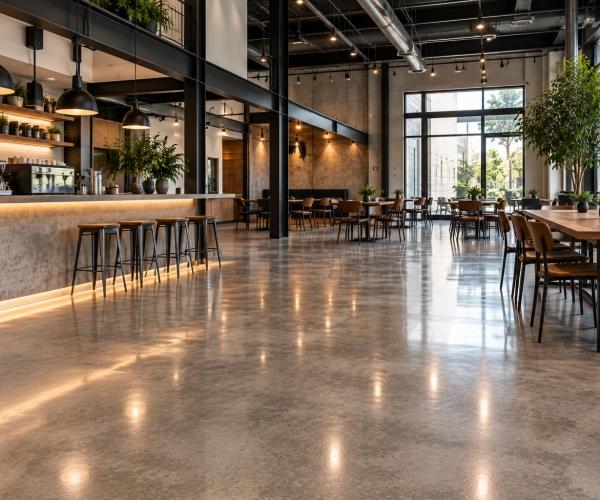
Commercial Concrete Floors for Austin Businesses
Commercial polished concrete is the slab already in your building, refined into the finished floor. Nothing is applied on top, so there’s no coating to fail under traffic. We polish warehouses, retail units, offices and restaurants across Austin.
Request A FREE Quote
It suits buildings where the floor takes a beating and still has to look presentable. Distribution space with forklifts running all day. A showroom where the finish is part of the brand. An office fit-out where the slab is already exposed and nobody wants carpet again. Whatever the building does, the floor’s already there. We’re refining it rather than replacing it, and that’s usually the cheapest square metre in the fit-out. Estimates are free and start with someone walking the floor.
The commercial argument is mostly about what you don’t spend later. A coated floor has a service life and a recoating cost attached to it. A polished slab has neither, because the finish comes from the density of the concrete rather than from a film sitting on it. Over a ten-year lease that difference is usually larger than the difference in installation.
We only polish. Not coatings, not overlays, not staining. If a coating is genuinely the right answer for your building, we’ll say so rather than sell you the thing we happen to do. That happens often enough on commercial jobs that it’s worth stating up front.
How a commercial floor gets polished
We check the slab’s hardness, flatness, moisture movement, cracking and coating history. That last one matters more than people expect, because a floor that’s carried a coating for a decade grinds differently from one that’s been bare since it was poured.
Failed coatings, adhesive, line-marking paint and mastic come off mechanically. Cracks and spalled areas are filled with color-matched material. Control joints get filled where the floor carries forklift or pallet-jack traffic, because an unfilled joint edge chips under hard wheels and the damage spreads from there.
Coarse diamond tooling opens the surface and flattens high spots. On a large slab this sets the schedule, and it’s where we work out how the floor gets sectioned so you can keep operating around us.
Lithium densifier reacts with free lime inside the concrete and hardens the slab from within. This is what makes the floor abrasion resistant rather than just smooth, and on a warehouse slab it’s the difference between a finish that survives forklift traffic and one that dusts.
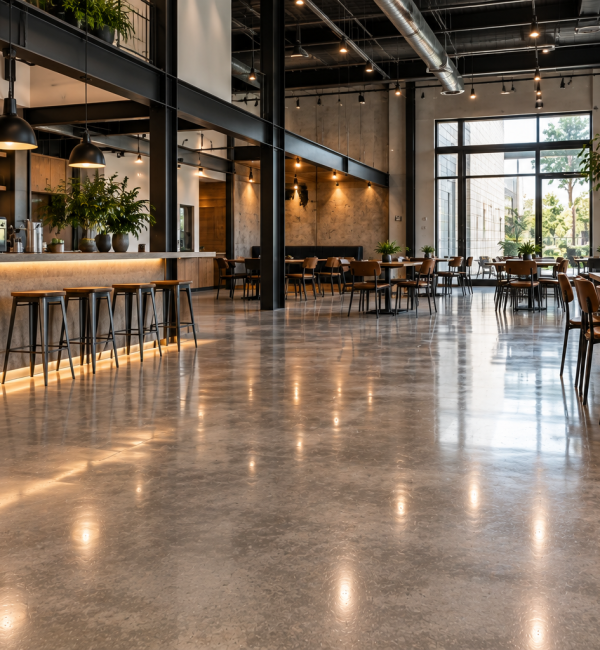
Progressively finer grit stages take the surface to the sheen you specify. Matte suits back-of-house and warehouse space, where a low sheen hides tyre marks and dust. Satin works in production areas and restaurants. High gloss carries light across a showroom or lobby.
A penetrating sealer guards against oil and water staining, which on a commercial floor matters most around loading doors and kitchen lines. It soaks in rather than sitting on the surface, so there’s nothing to wear through where the traffic concentrates.
How the floor gets sectioned is agreed before we start, not worked out on the day.
Where polished concrete works commercially
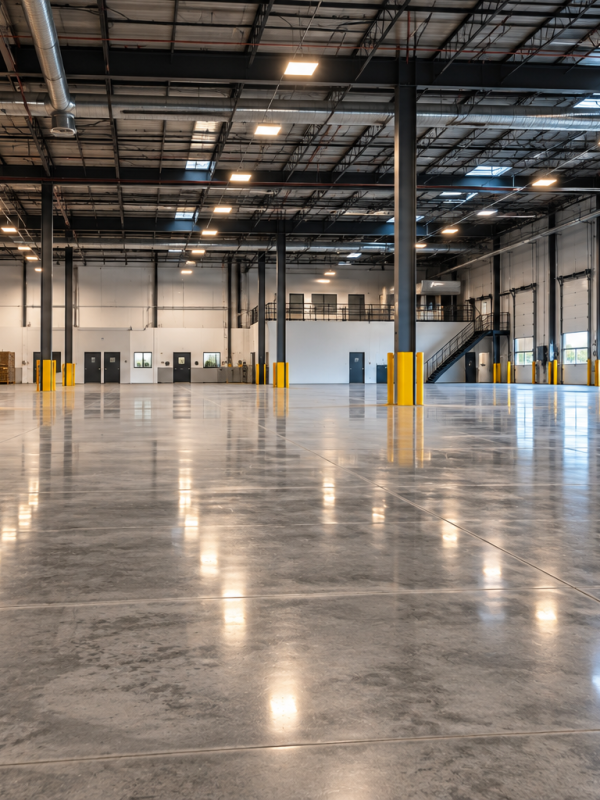
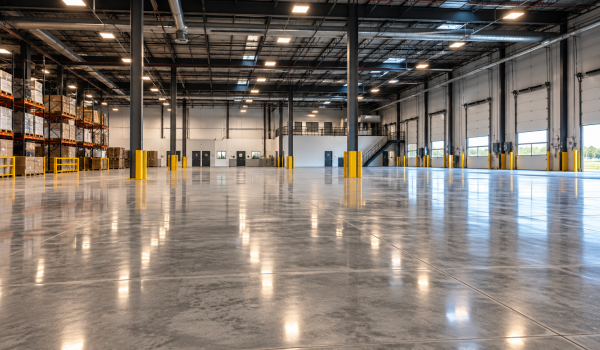
Warehouses and distribution floors, where the slab has to take forklift traffic and constant rolling loads without a coating breaking up under it.
Manufacturing and workshop space, where dust control and cleanability matter as much as durability.
Retail units, where the floor is part of the fit-out and gets walked on all day. A polished slab takes trolley wheels, display moves and constant footfall without the seams and edges that vinyl or tile give up at.
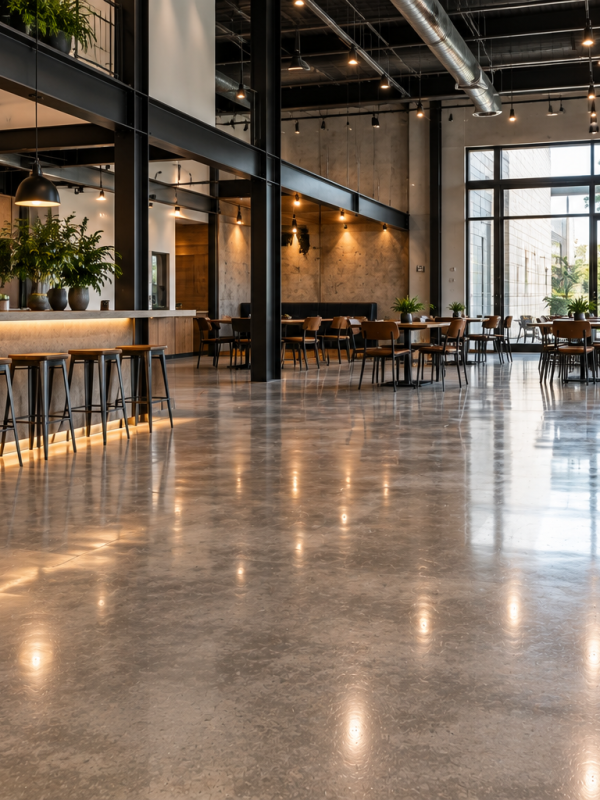
Restaurants and bars, where a smooth, sealed, non-absorbent surface is a regulatory question as well as a practical one. The Texas Food Establishment Rules set out what’s required of flooring in food preparation areas, and it’s worth reading before specifying anything. Front and back of house usually want different finishes, and drainage falls need agreeing before we start.
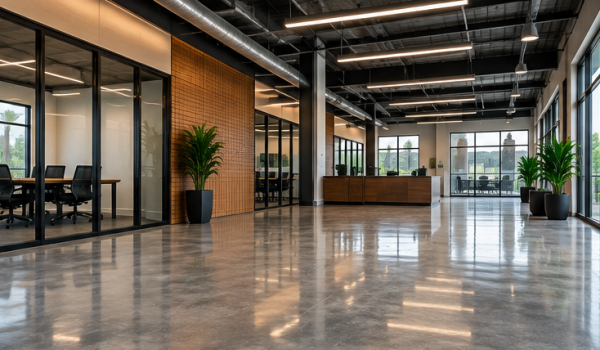
Offices, showrooms and lobbies, where the finish level does more work than the durability. An exposed slab in a fit-out is usually already there under carpet tiles. Showrooms are where high gloss earns its place, because the reflection does something a matte floor cannot.
Why businesses work with us
We polish and nothing else, which means the person quoting your floor has ground several hundred slabs rather than a handful between other trades. On a commercial job that shows up in the estimate, because the person writing it has seen what your slab is likely to do.
We assess before we quote. Nobody prices a commercial floor accurately from a square-footage figure, because the coating history and the condition of the joints decide the timeline far more than the area does. Estimates are free.
We’re straight about limitations. Some slabs won’t give you the finish you have in mind, and you’ll hear that at the assessment rather than after the grinders are running and half your floor is out of use.
We coordinate with your site schedule to minimise disruption. On most commercial jobs that means sectioning the floor and working through it in phases rather than closing the whole space at once, and it’s worth agreeing which areas can be released before anything starts rather than negotiating it mid-job.
Polishing Austin floors since 2012, with more than 1,000 completed projects. Fully insured. We hold no certifications we can’t show you and name no trade bodies we don’t belong to.
Commercial work across Central Texas
We work on commercial floors throughout Austin and out across the metro. That includes Round Rock retail units and Pflugerville distribution space, both of which have grown fast enough that a lot of the stock is recent and the slabs are in reasonable condition.
Further out we cover Georgetown office buildings, along with Cedar Park, Leander and Hutto. If you’re outside that list it’s still worth asking, because on commercial work the size of the floor matters more than the drive.
Commercial slabs around here tend to be newer than the residential stock, and that usually works in your favour. A slab poured in the last fifteen years is more likely to be flat, consistent and free of the patchwork of pours you find in an older house that’s been extended twice. Large commercial pours are also laid to tighter tolerances, so there’s less variation across a single floor.
What varies more is what’s been put on top. A warehouse that’s carried a coating through two tenancies is a different job from a bare slab in a new fit-out, and that shows up in preparation time rather than polishing. It’s the part of the quote that moves most once we’ve seen the floor.
Frequently asked questions
Can you polish while we stay open?
Usually, yes. We section the floor and work through it in phases so the rest of the space stays in use. How much can stay open depends on the layout and the size of the areas we can isolate. Grinding is loud and dusty even with extraction running, so it’s worth planning which parts of the operation can move around it before we start.
How does polished concrete hold up to forklift traffic?
Well, provided the joints are handled properly. The polished surface itself is hardened right through by the densifier rather than coated, so there’s no film for hard wheels to lift. The failure point on a forklift floor is almost always the control joints, which is why we fill them rather than leaving the edges exposed to chipping.
Is polished concrete suitable for a commercial kitchen?
It can be, and it’s worth checking the requirements first. Food preparation areas have rules about smooth, durable, non-absorbent flooring, and a sealed polished slab can meet them. Drainage falls and slip resistance in wet areas need specifying properly rather than assuming, so tell us what the space is used for before we quote.
What does it cost compared with a coated floor?
Installation is broadly comparable and the difference is what happens afterwards. A coating has a service life and a recoating cost. Polishing has neither, because nothing was added that can fail separately. Over a lease term the polished floor is usually the cheaper of the two, though the honest answer depends on the condition of your slab.
How long does the work take?
It depends on square footage and how much preparation the slab needs, and preparation is where the variation is. A bare slab in a new fit-out moves quickly. A floor with a failed coating, damaged joints and years of adhesive takes considerably longer, and we’d rather tell you that at the assessment than discover it mid-job.
What maintenance does a commercial floor need?
Very little. Regular sweeping, since grit is what dulls a polished surface, and a pH-neutral cleaner with an auto-scrubber for wet cleaning. No waxing, no stripping, no resealing schedule. Over several years of heavy traffic the sheen softens along the main routes, and burnishing restores it without regrinding the slab.
Request a site walkthrough
Based in Austin, Texas. Open Monday to Friday, 7:00 AM to 6:00 PM.
Call (512) 900-5938 or request an estimate and we’ll arrange a time to walk the floor with you.