Polished Concrete Hutto, TX
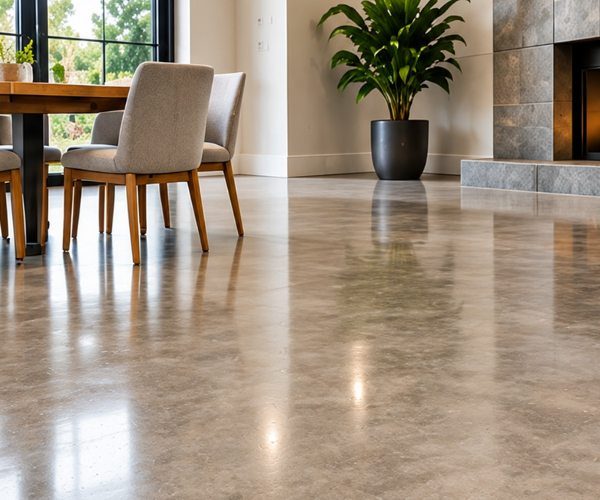
Polished concrete in Hutto is the slab already under your house, ground through grit stages into the finished floor and hardened with a densifier. Nothing is added on top of it, so nothing sits there waiting to fail.
Request A FREE Quote
Hutto sits on Blackland prairie, and that shapes every floor here. The soil is heavy clay that swells when it’s wet and shrinks when it’s dry, and slabs move with it. Nothing added on top survives that indefinitely, which is the argument for polishing rather than covering. We walk the slab before pricing it, at no charge. On a Hutto job that first visit matters more than most, because what we’re reading is the crack pattern rather than the square footage.
Most of what we do here is whole-house work. Kitchens, living rooms and hallways, usually where builder’s carpet or tile is lifting anyway and the slab underneath is sound.
Garages are the other half of it, and they nearly always arrive the same way: a coating that started peeling at the door edge.
What polishing won’t do is hide the slab. It shows what’s underneath, cracks included, so we tell you what will come out and what won’t before we start rather than after the grinders are already running.


What we find on Hutto slabs
Hutto is in Williamson County, roughly seven miles east of Round Rock and twenty-two from Austin, and it sits on Blackland prairie soil. That’s the single most important thing about polishing floors here.
Blackland clay is expansive. It swells with moisture and shrinks in drought, and across a Central Texas summer that movement is significant. Slabs sitting on it develop cracks more often than slabs on the limestone further west. It’s not a defect and it doesn’t rule out polishing, but it does mean we spend longer on the assessment here than almost anywhere else we work.
What we’re checking is whether a crack is still moving. A settled crack gets filled with color-matched material and becomes part of the floor. One that’s still working will open again after it’s filled, and filling it early just means filling it twice. On Blackland soil that distinction matters more than it does elsewhere.
The housing stock splits cleanly. Hutto was a cotton town from 1876 until the 2000s, and it went from about 1,250 residents in 2000 to roughly 46,000 today. The Old Town core around East Street holds the handful of genuinely old properties, and those slabs behave like any long-lived building: additions, converted spaces, more than one pour meeting in a room.
Everything else is recent. The subdivisions built through the 2000s and 2010s sit on prepared sites with modern slabs, and those grind evenly and quote predictably, clay underneath notwithstanding.
How the work runs
Assessment. We check hardness, flatness, cracking, coating history and whether damp is rising through the concrete. On a Hutto slab we spend extra time on cracks specifically, working out which have settled and which are still moving, because the clay underneath makes that the deciding question.
That’s the part of a quote most likely to change once we’ve seen the floor, and it’s the reason we won’t price this city from a phone call.
Preparation. Old coatings, adhesive, paint and tile thinset come off mechanically rather than with solvents. Settled cracks and spalled areas get filled with color-matched material so they read as part of the floor rather than as obvious repairs. Control joints get filled where a floor carries vehicle traffic.
Grinding. Coarse diamond tooling opens the surface and flattens high spots. This is the dusty stage and we run vacuum extraction throughout, sealing off rooms we aren’t working in so the rest of the house stays usable.
What we watch for is how evenly the slab opens. On a newer Hutto build it usually opens consistently. In an older Old Town property it rarely does, because a room addition or an enclosed porch normally means a second pour, and concrete laid decades apart doesn’t grind the same.
Densifying. Lithium densifier reacts with free lime inside the concrete and hardens the slab from within. That’s what makes the floor abrasion resistant rather than merely smooth, and in a garage it’s also what resists hot tyre marking.
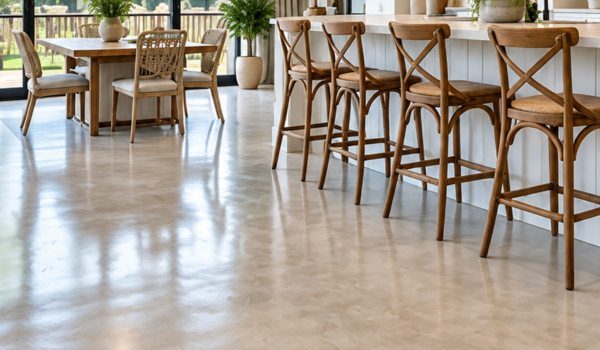
Polishing. Progressively finer grit stages take the surface to the sheen you chose. Matte hides dust and suits garages and workshops. Satin sits in the middle and works through most of a house. High gloss throws light across an open floor and shows every footprint with it.
Grinding depth is a separate decision from sheen. Stop shallow for a cream finish with little stone showing, or go deeper and the aggregate appears. We bring samples so you’re choosing from something you can hold rather than a photograph.
Sealing. A penetrating sealer guards against oil and water staining. It soaks into the concrete rather than sitting on top, so there’s nothing on the surface to wear through or reapply on a schedule.
A single garage runs one to two days from first grind to final seal. A whole ground floor takes longer, and we’ll give you a realistic window rather than an optimistic one.
Why Hutto homeowners work with us
We only polish. Not coatings, not overlays, not staining. On a slab that moves with the clay underneath, a coating is the wrong answer twice over, because it hides movement until it fails and then fails visibly.
We assess before we quote, and estimates are free. Nobody prices a floor accurately over the phone, and on Blackland soil that’s more true than usual, because the crack pattern is what decides the work.
We’re straight about limitations. If a crack is still moving, we’ll tell you it needs to settle before it’s worth filling, even though that means waiting rather than booking. Filling a live crack is money spent twice.
Hutto is about twenty-five miles out, so we schedule work there in blocks where we can. It’s worth asking when we’re next heading that way rather than assuming a single garage isn’t worth the trip.
Working on a clay-soil slab is a different assessment from working on limestone, and it’s worth having someone who knows the difference look at it before anything starts.
Established 2012, more than 1,000 floors completed across Central Texas. Fully insured. We hold no certifications we can’t show you and name no trade bodies we don’t belong to.

Frequently asked questions
How much does polished concrete in Hutto cost?
Crack repair is what moves a Hutto quote. On Blackland clay most slabs have some, and the work depends on how many have settled enough to fill. A newer build with two or three hairlines prices very differently from an older floor with movement across several rooms. That is why we will not price this city from a phone call, and why the assessment is free.
My slab has cracks. Can it still be polished?
Usually, yes. Cracks are normal on Blackland clay and they don’t rule out polishing. What matters is whether a crack has settled or is still moving. Settled cracks get filled with color-matched material and become part of the floor. A live crack will reopen after filling, so we’d rather wait than charge you twice for the same repair.
Does the clay soil cause problems for polished floors?
Not for the finish itself. A polished surface is the concrete, so it moves with the slab rather than sitting on top of it. That’s actually an advantage here. A coating stuck to a slab that’s shifting seasonally is the arrangement most likely to fail, which is why coated floors around Hutto tend to show cracking at the surface sooner than the concrete does.
What if my garage floor was coated?
It comes off before anything else happens. Grinding a coating back to bare concrete is preparation for a polish rather than a separate job, and on a slab that moves with clay underneath it is usually already failing at the edges. That is the part of the timeline hardest to judge without seeing it, which is why we look first.
What about an older place in Old Town?
Those we look at carefully. A property that’s been standing since the cotton era has usually been extended or altered, which means more than one pour and an uneven grind. It doesn’t rule polishing out, but it does change what we can promise about consistency across a room, and you should see samples first.
How long should I wait if a crack is still moving?
Longer than most people want to hear, and it depends on the crack. Seasonal movement on Blackland clay follows the weather, so we would usually want to see a slab across a wet spell and a dry one before calling a crack settled. If yours is clearly still working, we will say so and suggest coming back rather than filling it twice.
Book a free estimate
Based in Austin, Texas, working throughout Hutto and Williamson County. Open Monday to Friday, 7:00 AM to 6:00 PM.
Call (512) 900-5938 or request an estimate and we’ll arrange a time to look at the floor.