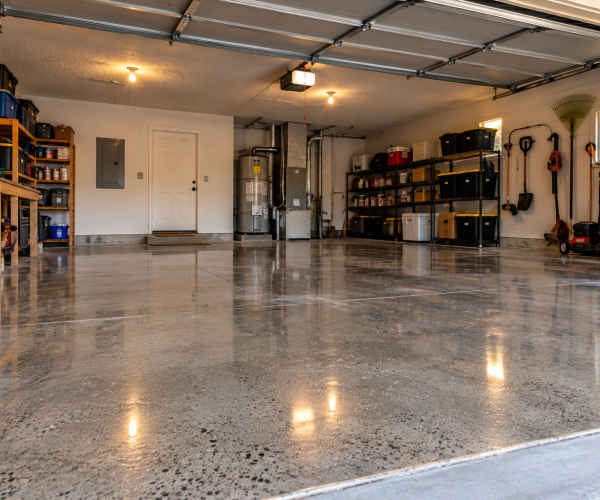
Polished Concrete Garage Floors in Austin
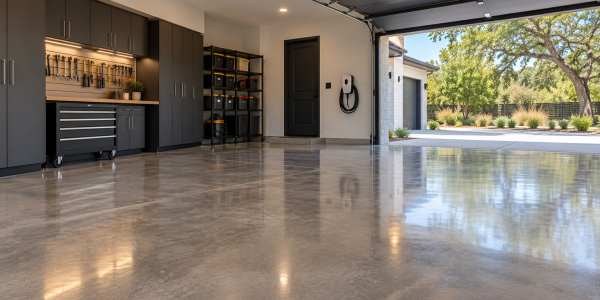
Garage floor polishing takes the slab already under your car and grinds it into the finished floor. Nothing is applied over the top. We polish garages across Austin and Central Texas, for parking, storage, gyms and workshops.
Request A FREE Quote
Most Austin garages already have the floor. It’s under the shelving, the bikes and a decade of tyre marks, and it’s usually in better condition than the owner expects once we’ve seen it. Polishing it costs less than covering it, and estimates are free.
It suits garages that do more than hold a car. A home gym where dropped weights would crack tile. A workshop where solvent spills would lift a coated floor. Storage where you want to sweep rather than vacuum. And parking, where the enemy is hot tyres rather than foot traffic, and where a coated floor tends to give up first.
What it does not do is hide the slab. A polished garage floor shows what’s underneath, including old stains and previous patches. That’s the trade against a coated floor, which covers everything and then has no coating to lift when the slab heats up. We’ll tell you what will come out and what won’t before anything starts, because the alternative is finding out together on day two.
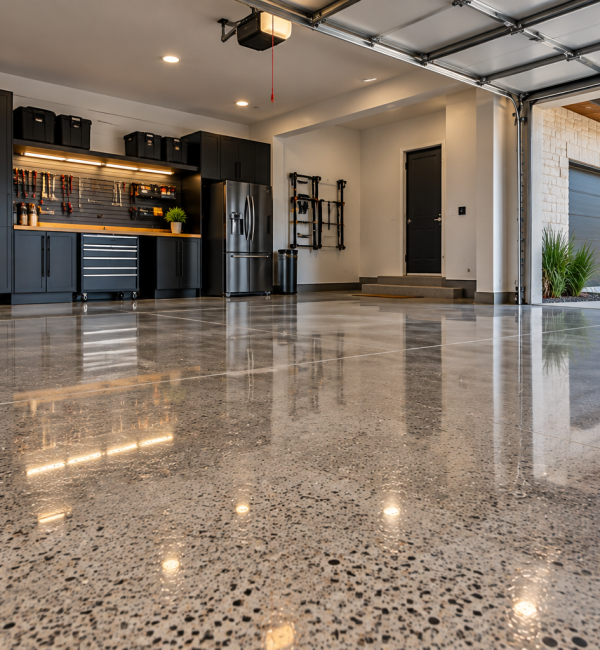
How a garage floor gets polished
Assessment. We check the slab’s hardness, flatness, any coating history, and how much aggregate sits near the surface. In a garage we also look at the fall towards the door, because a floor that drains needs a finish that stays safe when it’s wet.
Old paint, sealer and failed coatings come off mechanically. Oil staining gets drawn out where it can be, and where it can’t we’ll say so. Cracks and spalled areas are filled with color-matched material, and the control joint at the door gets attention because that’s where vehicle weight concentrates.
Coarse diamond tooling opens the surface. This is the dusty stage and we run vacuum extraction throughout, though a garage is easier than a house because the door gives us ventilation and somewhere to put the equipment.
Lithium densifier reacts with free lime inside the concrete and hardens the slab from within. On a garage floor this matters more than the shine. Hot tyres sitting on a soft surface are what causes marking, and a densified slab resists that in a way an untreated one does not.
Progressively finer grit stages take the surface to the sheen you choose. Matte hides dust and tyre marks and suits workshops and gyms. Satin sits in the middle. High gloss shows the floor off and shows every footprint with it, which is worth knowing before you pick it.
A penetrating sealer guards against oil and water staining. It soaks in rather than sitting on top, so there’s nothing to peel when the slab expands in August.
Anti-slip treatment is available where the floor slopes toward the door or the garage doubles as a workshop. It changes the feel underfoot rather than the look.
Choosing a finish for a garage
Matte suits a working garage. Low sheen, hides dust and tyre marks between cleans, and it’s the most forgiving of an older slab.
Satin is the middle ground and the most common choice. Enough reflection to lift the space, not so much that every mark shows.
High gloss belongs in a garage that gets looked at. Collectors, showpiece builds, anything with lighting. It’s the least forgiving finish on an imperfect slab and the most striking on a good one.
Grinding depth is a separate decision. Stay shallow for a cream finish with little stone showing. Go deeper and the aggregate appears. On a garage slab the depth is often limited by what’s near the surface, and we’ll bring samples so you’re choosing from something you can hold.
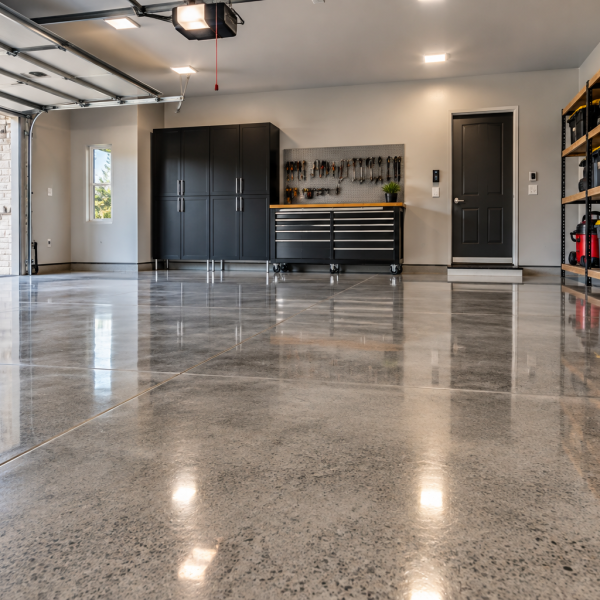
Why homeowners work with us
We only polish. Not coatings, not overlays, not staining. In a garage that matters more than most rooms, because the coated garage floor is the thing most people are trying to replace.
We assess before we quote, and nobody prices a garage floor accurately over the phone. The condition of the slab decides the timeline far more than the square footage, and a two-car garage with a failed coating takes longer than a three-car garage that’s been bare since it was built.
We’re straight about what will come out. Oil that’s been sitting in a slab for years sometimes stays visible after polishing, and no amount of grinding changes that. You’ll hear it at the assessment rather than after the grinders have run and the garage is already empty.
A garage is also the easiest room in the house to get wrong, because it’s the one people treat as an afterthought until the coating starts lifting. We’d rather spend an extra twenty minutes at the assessment than have you paying for the same floor twice.
Established 2012, with more than 1,000 polished floors behind us. Fully insured. We hold no certifications we can’t show you and name no trade bodies we don’t belong to.
Garages in Central Texas
Austin garages take a particular kind of punishment. The slab sits behind a door that opens onto direct sun for most of the year, and the temperature swing between a closed garage in August and an open one in January is larger than anything the rest of the house sees.
That’s the practical case against a coated garage floor here. Coatings bond to the slab, the slab moves with the heat, and the bond is where it fails. It usually shows at the door edge first, then spreads. A polished floor has no bond line because nothing was added to it.
Dust is the other local factor. A lot of driveways here are unsealed or gravel-edged, and what gets carried in on tyres is abrasive enough to matter. It’s the main thing that dulls a polished garage floor over time, and it’s also why we recommend matte or satin over high gloss for a garage that’s actually used.
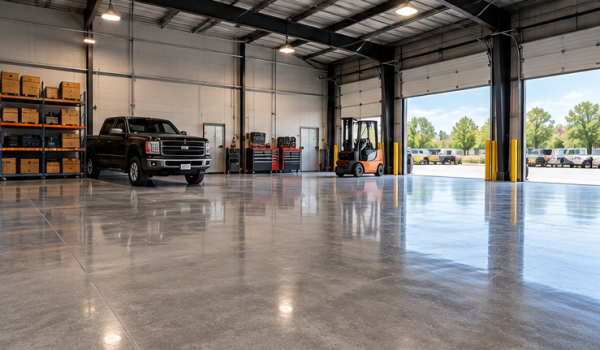
We polish garages throughout Austin and across the metro, including Round Rock garages and Cedar Park workshops, and out as far as Georgetown, Leander, Pflugerville and Hutto. Garage work travels well, so distance matters less here than it does on a larger commercial job.
Frequently asked questions
How much does garage floor polishing in Austin cost?
It depends on the size of the garage, the condition of the slab and how much preparation it needs. A bare slab in reasonable condition moves quickly. One with a failed coating, oil staining and cracked joints takes considerably longer, and preparation is where most of the labour goes rather than the polishing itself. Estimates are free and include someone coming out to look at the floor first.
Will hot tyres mark a polished garage floor?
Not the way they mark a coated one. Hot tyre pickup happens when a coating softens under a warm tyre and lifts away with it. There’s no coating on a polished floor, so there’s nothing to lift. A densified slab is also harder than an untreated one, which is what resists the marking in the first place. It’s the single most common reason Austin owners move away from coated garage floors.
Can you polish a garage floor with oil stains?
Usually, and how much comes out depends on how deep it went and how long it sat. Fresh surface staining generally grinds away. Oil that’s soaked into an untreated slab over years can stay visible as a shadow even after grinding. We check for it at the assessment and tell you plainly what to expect rather than promising a clean slate.
Is a polished garage floor slippery when wet?
Less than most people assume, and it can be adjusted. A polished surface has more traction than sealed tile or a coated floor because the finish comes from the density of the concrete rather than a film on top. Where the floor slopes toward the door, or the garage doubles as a workshop, we can apply an anti-slip treatment that changes the feel underfoot without changing the look.
Do I need to empty the garage first?
Yes, completely. We need the whole slab clear, including shelving along the walls, because the edges need grinding as much as the middle. Most people use the driveway for a couple of days. If there’s built-in storage that can’t move, tell us at the assessment and we’ll work out what’s realistic rather than discovering it on the morning.
How long does a garage take?
Most single and double garages run one to two days from first grind to final seal. Larger garages and workshops take longer, and so does any slab that needs significant preparation. You won’t be able to park on it while we’re working, and we’ll tell you when it’s ready to take a vehicle again rather than leaving you to guess.
Book a free estimate
Based in Austin, Texas. Open Monday to Friday, 7:00 AM to 6:00 PM.
Call (512) 900-5938 or request an estimate and we’ll arrange a time to look at the floor.