
Why it matters before you lift anything
People pull carpet expecting to find a floor. What they find is a record of every flooring decision anyone has made in the building since it was poured.
That’s not a problem in itself. It’s just information nobody has, including the current owner, until something comes up.
That record decides the cost of polishing, the timeline, and occasionally whether it’s worth doing at all. It’s also almost entirely invisible until something comes up, which is why estimates given over the phone are guesses.
The good news is that most of it is fine. Tack strip holes fill. Adhesive grinds off. Thinset grinds off with more effort. The situations that stop a job outright are rare, and they’re identifiable early.
The other reason to look is simpler. Plenty of people are living on a slab they’d be happy with and don’t know it, because it has been under carpet since before they moved in.
How to check without committing

Lift a corner. A closet is ideal, or behind a door where the carpet meets a wall somewhere out of sight. Anywhere you won’t mind if the edge ends up slightly worse than it started.
Carpet is held at the edges by tack strip, a thin batten with upward-pointing nails, fixed to the slab every few inches around the perimeter. Pull the carpet back from a corner with a pair of pliers and it comes away from the strip without damaging the rest of the room.
Underneath the carpet is padding, usually foam or rubber, held down with staples or spray adhesive. Under that is whatever was there before. Lift a square foot of padding and the slab is visible.
What you’re looking for takes about a minute to assess, and the carpet goes back down afterwards. Nothing about this commits you to anything.
One caution. Carpet that has been down a long time can be brittle at the edges, and pulling hard enough to tear it turns a look into a job. Work slowly, and stop if it resists.
What you’ll probably find
Five things, in rough order of how often they turn up under a lifted corner.
Tack strip holes around every perimeter. Small, regular, every few inches along every wall. They fill during preparation and disappear into the finished floor. On a house that has had carpet for decades there are hundreds of them, and filling them is a real line in the timeline rather than a formality.
Carpet adhesive. Patchy, yellow or brown, sometimes only in traffic areas and sometimes across the whole floor. It grinds off. Older adhesives are harder than newer ones, and the black ones in houses of a certain age are the slowest to shift.
Staples and their holes. These come from the padding rather than the carpet, and they’re scattered across the field of the floor rather than confined to the perimeter. Same treatment as tack strip, just more spread out.
Thinset. Grey, hard, and set in a ridged pattern left by the trowel. It means tile was down at some point, and it’s the most stubborn of the common layers. The ridges are the giveaway: nothing else leaves that pattern.
Self-levelling compound. A smooth pale layer that looks like a second, neater slab sitting on the first. It was poured to correct an uneven floor, and how much of a problem it presents depends on how thick it went down and whether it bonded properly.
When it’s thin and well bonded it can sometimes be polished as if it were the slab. When it’s thick, or lifting anywhere, it all has to come off, and that is the one finding on this list that genuinely changes a quote.
What each one means for the work
Directional rather than precise, because the answer always depends on how much of the stuff there is and how well it stuck.
What you find | What it means for the work |
|---|---|
Tack strip holes | Filled during preparation. Routine, but hundreds of them on an old floor |
Carpet adhesive | Grinds off. Older and darker adhesives take longer |
Staples and staple holes | Same as tack strip, spread across the floor rather than the perimeter |
Thinset | The most stubborn common layer. Means tile was down at some point |
Self-levelling compound | Thin and bonded, sometimes polishable. Thick or lifting, all of it comes off |
Layers stack. A house that had tile, then carpet, has thinset under the adhesive. Each layer comes off before the one beneath it can even be assessed, which is why a floor with two generations of covering takes longer than twice a floor with one.
Age predicts this better than anything else. A house from the fifties or sixties has had six decades of flooring decisions made on it. A build from the last fifteen years has usually had none, and what you find under the carpet is the slab.
The signs that matter more than the layers
Three things deserve more attention than whatever happens to be glued to the surface.
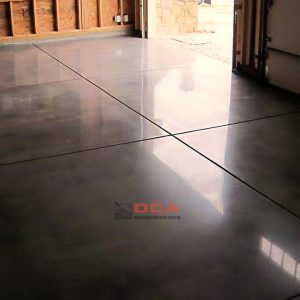
Cracks. Look at whether the two sides sit level with each other, and whether the edges are sharp or crumbled. A hairline that has settled becomes part of the finished floor and stops being noticeable within a week of moving back in. One that’s still moving needs to settle before filling is worth doing, because filling a live crack means filling it twice, and telling them apart properly needs a site visit rather than a photograph.
Level changes between rooms. A step or a slope where two areas meet often means two pours from different eras, usually an addition meeting the original house. Those grind differently, so a continuous finish across both may not be achievable. It’s worth knowing that before you commit to the idea of one uninterrupted floor, rather than after the grinders have run.
Dark patches or a white powdery bloom. Both suggest moisture moving up through the slab. Neither rules polishing out, and polished concrete handles it better than a coating would, but it changes what gets specified and occasionally when the work can start.
The white bloom has a name, efflorescence, and it’s salts carried to the surface by rising water and left behind when the water evaporates. It cleans off. It comes back if the moisture underneath isn’t understood.
When the slab isn’t worth uncovering
Not often, but it happens, and it’s better to know before the carpet is in a skip.
A slab poured for utility rather than appearance. Heavy trowel marks, aggregate at wildly inconsistent depths, or a surface that was never intended to be seen by anyone. It will polish. It won’t be uniform, and if what you want is uniform then this is the wrong floor to chase.
Extensive structural cracking. Wide cracks with level differences between the two sides, or a pattern that suggests foundation movement, is a structural question rather than a flooring one, and it needs answering before anyone thinks about a finish.
A moisture source that isn’t resolving. A slab with water finding its way in from outside, or a missing vapour retarder in a room that stays damp, will keep telling you about it whatever goes on top of it. Fixing the cause comes before choosing a floor.
There’s a fuller account of when polishing is the wrong answer elsewhere on the site. None of these three situations is common, and finding one is not the usual outcome of lifting a corner.
What to do with what you find
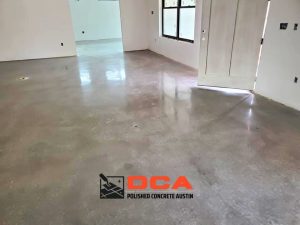
If the corner looks straightforward, it probably is, and the rest of the room is likely to match. Flooring was almost always laid room by room in one go, so what you see in one corner is a fair sample of the rest of that room. It says nothing about the next room along.
If you find thinset, self-levelling compound, or anything suggesting more than one layer, mention it when you ask for a quote. It won’t stop the job. It will change the number, and a contractor who hears about it upfront gives you a more honest figure than one who discovers it on day two.
That cuts both ways. A quote given without anyone knowing about the thinset is a quote that gets revised, and the revision always arrives at the least convenient moment.
If you find cracks with level differences between the two sides, or damp patches anywhere, stop there and get someone to look at it before you take up the rest of the room.
And take a photograph of the corner before you put the carpet back. It’s the single most useful thing you can send a contractor before they visit, even though it doesn’t replace the visit. Include something for scale, a coin or a tape measure, because a close-up of concrete tells nobody anything about the size of what they’re looking at.
There’s more on which of these variables actually moves a quote, and on what to ask whoever you’re getting one from.
Established 2012, working across Austin and Central Texas. Fully insured, no subcontractors, and estimates are free.
Call (512) 900-5938 or request an estimate, and we’ll read the whole floor rather than one corner of it.