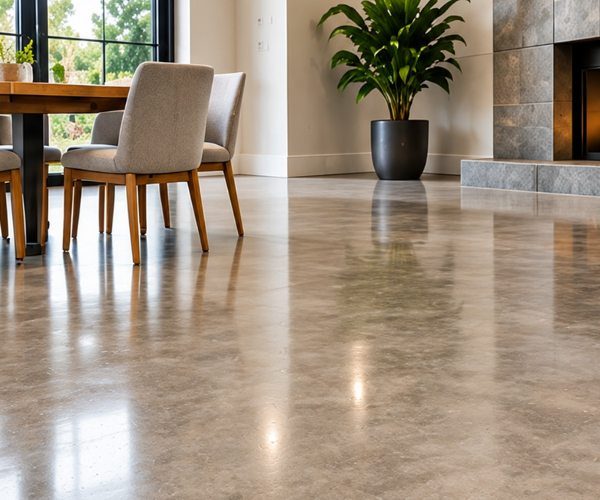
Polished Concrete West Lake Hills, TX
Polished concrete in West Lake Hills is the slab already in your house, taken down through diamond grit stages and hardened with a densifier. Nothing gets laid over the top of it.
Request A FREE Quote
Because nothing is added, there’s nothing that can fail separately later. We walk the floor before quoting, and that visit costs nothing.
Almost everything we do here is residential, and most of it arrives one of two ways. Renovation work, where the old flooring is coming up and the owner wants to see what’s underneath. Or a custom build where the architect specified an exposed slab and someone has to deliver it.
On a house this size the assessment matters more than usual, because a large continuous floor gives you nowhere to hide an inconsistency.
The finish argument here is different from most places. This isn’t about durability, which polished concrete has in any case. It’s that a single uninterrupted surface running through an open plan does something no laid floor manages, and on a Hill Country house built around its views that reads as deliberate rather than economical.
What polishing doesn’t do is hide the slab. It shows what’s underneath, so we say what will come out and what won’t before anything starts.
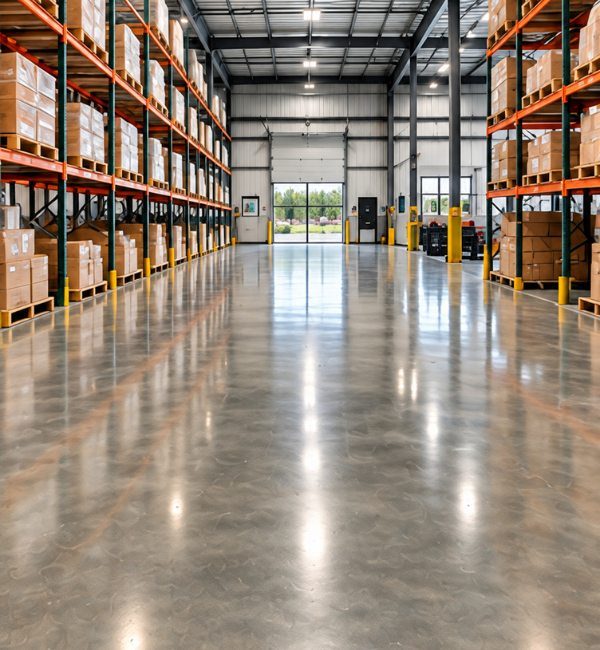
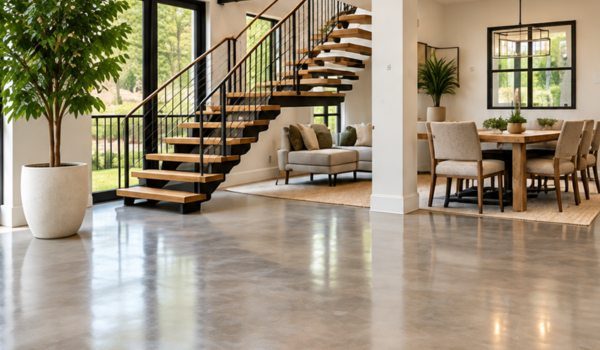
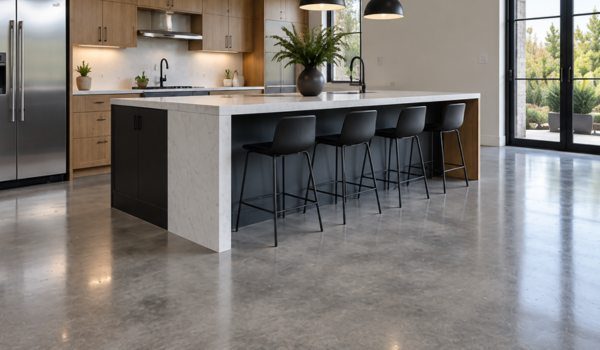
What we find on West Lake Hills slabs
West Lake Hills sits on the eastern edge of the Edwards Plateau, six miles west of downtown Austin, and the geology here does something useful for a polished floor.
Most parcels sit on limestone shelves with shallow topsoil. Foundations are frequently broken and pinned into rock, which costs more to build but produces an exceptionally stable base. Compared with the expansive clay east of Austin, these slabs move very little seasonally. Less movement means fewer cracks, and fewer cracks means a more predictable finish across a large continuous floor.
That matters more here than it would elsewhere, because the houses are large and often open plan. A slab that stays still is what makes an uninterrupted surface achievable across a whole ground floor.
The building stock splits by era. The city incorporated in 1953 and grew slowly, from about 700 residents in 1960 to roughly 3,400 today, so there’s a real spread. Original mid-century and seventies houses, many of them since renovated to the studs. Eighties and nineties builds. And current Hill Country Modern work, where the slab is often specified as the finished floor from the outset.
Renovation is the common thread. A house here has usually been altered at least once, which can mean more than one pour meeting in a room. On a large open floor that shows, so we walk it carefully and bring samples before anyone commits to a finish level.
How the work runs
Assessment. We check hardness, flatness, cracking, coating history and whether moisture is moving up through the slab. On a renovated house the pour history is the main question, because additions and conversions rarely grind the same as the original.
Preparation. Tile thinset, adhesive, old sealer and paint come off mechanically rather than with solvents. Cracks and spalled areas are filled with color-matched material so they read as part of the floor. On a house that has been through a major renovation there’s often more under the flooring than the owner expects.
Grinding. Coarse diamond tooling opens the surface and flattens high spots. This is the dusty stage, and we run vacuum extraction throughout while sealing off rooms we aren’t working in so the house stays usable.
What we watch for is how evenly the slab opens. Where a house is a single original pour it opens consistently, and a continuous finish across the ground floor is straightforward. Where an addition meets the original, the aggregate can shift noticeably in the middle of a room.
Densifying. Lithium densifier reacts with free lime inside the concrete and hardens the slab from within. That’s what makes the floor abrasion resistant rather than merely smooth, and it’s the reason a polished slab needs no coating at all to survive traffic.
Polishing. Progressively finer grit stages take the surface to the sheen you choose. Matte reads quiet and hides dust. Satin sits in the middle and suits most rooms. Higher sheen carries light through a room built around glazing, which on a house oriented to a view is often the point.
Grinding depth is a separate decision from sheen, and it matters more on a large floor than a small one. Stay shallow for a cream finish, or go deeper and the aggregate appears. We bring samples rather than photographs, because at this scale the difference is significant.
Sealing. A penetrating sealer guards against oil and water staining. It soaks into the concrete rather than sitting on top, so there’s nothing on the surface to wear through or renew on a schedule.
Anti-slip treatment is available where a floor runs out to a terrace or a pool surround, which on a house built around outdoor space is worth raising at the assessment.
Most whole-floor jobs run several days. We’ll give you a realistic window rather than an optimistic one, and we’d rather quote long and finish early.
Why West Lake Hills owners work with us
We only polish. Not coatings, not overlays, not staining. On a floor that’s meant to be the finished surface rather than a substrate, that narrowness is what you want, because whoever grinds it has done several hundred rather than a handful between other trades.
We assess before we quote, and estimates are free. Nobody prices a large continuous floor from square footage, because the pour history and the preparation decide the work.
We’re straight about what a slab will give you. If a floor won’t polish to a consistent finish across a room, you’ll hear it at the assessment rather than after the grinders have run. On a house where the floor is the design feature, that conversation is worth having early.
We also won’t push a finish that fights the house. High sheen looks striking in a photograph and shows every footprint in a hallway, and on a floor that runs continuously through the ground floor that is worth thinking about carefully before committing.
West Lake Hills is about ten miles from us, so scheduling is rarely the constraint here.
Polishing Central Texas floors since 2012, with well over 1,000 finished. Fully insured. We hold no certifications we can’t show you and name no trade bodies we don’t belong to.
Frequently asked questions
How much does polished concrete in West Lake Hills cost?
Square footage matters more here than in most places, simply because the floors are larger. Beyond that it’s the pour history and what’s currently over the slab. A single-pour house with tile coming up is straightforward. One that’s been extended twice, with a different flooring in each phase, takes longer. Estimates are free.
Can you polish a whole ground floor as one continuous surface?
Usually, and it’s the most common request here. The limestone underneath helps, because slabs that don’t move seasonally crack less and finish more consistently. What decides it is whether the house is a single pour. Where an addition meets the original the aggregate can shift, so see samples before committing.
Our house was renovated. Does that change anything?
It changes the assessment rather than the outcome. A renovation usually means a second pour somewhere, along with whatever flooring each phase left behind. Neither rules out polishing. Both affect how evenly the slab opens under the grinder, which is exactly what we’re looking for when we walk the floor first.
Is the limestone underneath actually an advantage?
For a polished floor, yes. Foundations here are often pinned into rock, which produces an unusually stable base. Slabs move far less seasonally than they do on the clay east of Austin, so cracking is less common and the finish holds more predictably across a large floor. It’s the best ground we work on.
The architect specified exposed concrete. Can you work to that?
Yes, and it’s worth involving us early rather than at handover. Finish level, grinding depth and how the slab was poured all interact, and some decisions are easier before the concrete goes down than after. If the slab is already in, we’ll tell you honestly what it will and won’t give you.
What does it need afterwards?
Very little, which is part of the appeal on a large floor. Sweeping and an occasional damp mop with a neutral cleaner covers it, and there’s no waxing, stripping or resealing cycle to schedule. Years of traffic soften the sheen along the main routes, and burnishing restores it without regrinding the slab.
Book a free estimate
Based in Austin, Texas, working throughout West Lake Hills and western Travis County. Open Monday to Friday, 7:00 AM to 6:00 PM.
Call (512) 900-5938 or request an estimate and we’ll arrange a time to walk the floor.