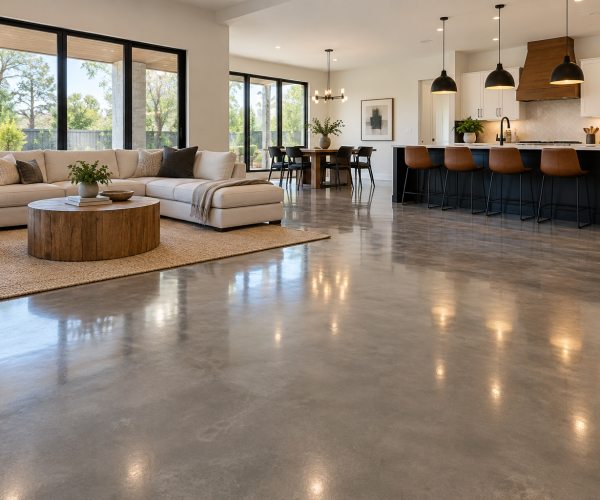
Polished Concrete Floors for Austin Homes
Residential polished concrete is the slab already under your house, ground through diamond grit stages and hardened into the finished floor. Nothing is applied over it. We polish kitchens, living areas, garages and patios for Austin homeowners.
Request A FREE Quote
It suits people mid-renovation who have pulled up carpet or tile and are looking at bare concrete, and people building new who want the slab finished before other trades arrive. In both cases the floor already exists. We refine it rather than replace it. Every job starts with a look at the actual slab, free of charge.
The practical appeal is what isn’t there. No covering goes on top, so there’s no coating to fail. No grout lines collecting dirt. No transitions between rooms. Nothing to swell if a dishwasher leaks, nothing for a dog’s claws to catch. Dust and allergens have nowhere to sit, which for households with asthma or a shedding dog matters more than the way it looks.
The visual appeal is real too, but it comes with a condition worth knowing early: the floor you get depends on the slab you have. Two houses on the same street routinely finish differently, and no photograph of someone else’s floor tells you what yours will look like. We’ll walk it with you before quoting and tell you what’s realistic for your house specifically.
How a home floor gets polished
Assessment. We check flatness, moisture movement, existing coatings, cracking and how much aggregate sits near the surface. In an occupied house we also work out sequencing room by room, because you generally can’t use a space while we’re in it and most families would rather not lose the kitchen and the living room in the same week.
Preparation. Carpet adhesive, tile thinset, flooring glue and old paint come off mechanically. Tack-strip holes around the perimeter get filled, and cracks are repaired with color-matched material so they read as part of the floor rather than as obvious repairs.
Grinding. Coarse diamond tooling opens the surface. This is the dusty stage. Adjoining rooms get sealed off and we run vacuum extraction throughout, but a working grinder in a house is not quiet and it’s worth planning around.
What we watch for here is how evenly the slab opens. In a house that’s been remodeled it rarely opens evenly. A room addition, a converted garage or an enclosed patio can mean a separate pour, and concrete laid twenty years apart doesn’t grind the same. One area starts showing aggregate quickly while the next stays cream.
Densifying. Lithium densifier reacts inside the concrete and hardens the slab from within, which is what makes the floor abrasion resistant rather than just smooth.
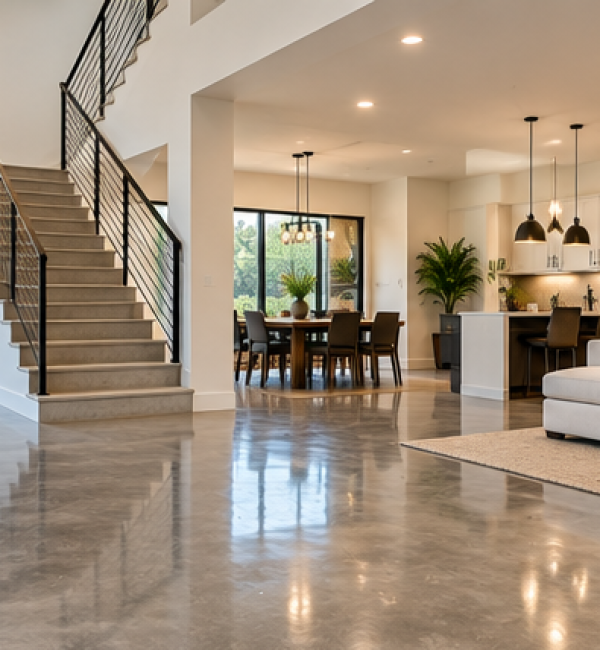
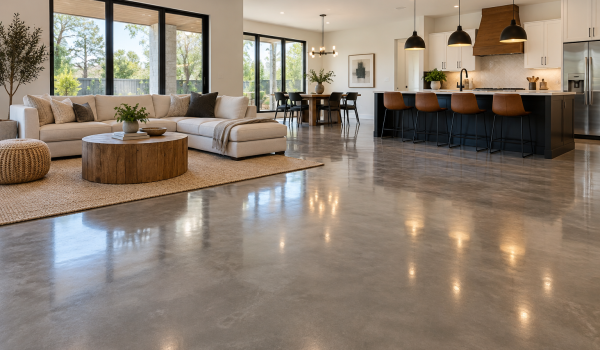
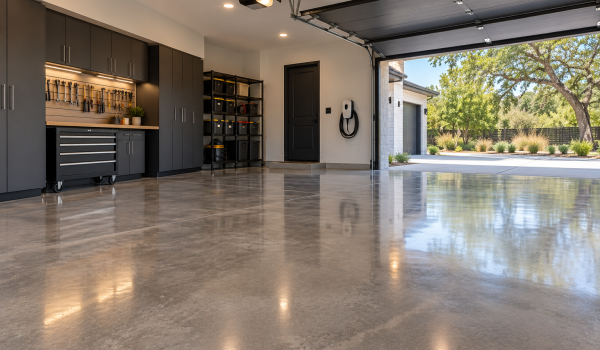
Polishing. Progressively finer grit stages take the surface to the sheen you chose. Matte hides dust and footprints, which suits busy households and garage floors. Satin sits in the middle and works in most homes. High gloss carries light through an open-plan space.
Grinding depth is a separate decision from sheen, and it’s the one homeowners find hardest to picture. Stop shallow and you get a cream finish, mostly smooth concrete with very little stone showing. Go deeper and the aggregate appears, first as a salt-and-pepper scatter, then as fully exposed stone. Deeper is not better, it’s just different, and how much aggregate sits near the surface of your particular slab limits how far we can reasonably go. We bring samples so you’re choosing from something you can hold rather than a photograph.
Sealing. A penetrating sealer guards against water and oil staining. It soaks in rather than sitting on top, so there’s nothing on the surface to wear through or reapply.
Most homes take a few days from first grind to final seal, depending on square footage and how much preparation the slab needs.
Why homeowners work with us
We only polish. Not coatings, not overlays, not staining. In a house that matters, because the person quoting your floor has ground several hundred slabs rather than a handful between other trades.
We assess before we quote, and estimates are free. Nobody prices a home floor accurately over the phone, because the condition of your slab decides the timeline and the result far more than the square footage does.
We’re honest about what a slab will give you. Some houses produce a floor better than the owner pictured. Some won’t, and you’ll hear that at the estimate rather than three days into the job when the grinders are already running and the carpet has gone to the tip.
Working inside an occupied house is different from working on an empty commercial slab, and we treat it that way. Adjoining rooms get sealed before anything starts. Anything staying in the space gets covered. We clean up at the end of each day rather than at the end of the job, because you still have to live there in between.
Polishing Austin floors since 2012, with more than 1,000 completed projects. Fully insured. We hold no certifications we can’t show you and name no trade bodies we don’t belong to.
Working in Austin homes
We polish floors throughout Austin and the central neighborhoods, out to Round Rock and across to Cedar Park.
As far west as Lakeway, then Leander, Georgetown, Pflugerville, Hutto.
A lot of Austin housing stock has been altered. Additions, converted garages, enclosed patios, kitchens opened into living rooms. Polished concrete doesn’t cover any of that up, and homeowners expecting a uniform floor are the ones most often surprised.
Aggregate exposure can shift across a single room. An old patch shows where a wall used to stand. A strip of different concrete marks where plumbing was rerouted. Where tile sat for thirty years, ghosting sometimes stays visible even after grinding, faint but there in the right light.
Some of that comes out and some doesn’t, and we’d rather show you which is which before we start. On most older houses the variation ends up reading as character rather than as a flaw, and homeowners who were braced for a fault often end up pointing it out to visitors. The aim isn’t to make a forty-year-old slab look like it was poured last week. It’s to understand what’s under the carpet, prepare it properly, and be straight with you about what the finished floor will look like.
Frequently asked questions
Is residential polished concrete cold underfoot?
Less than people expect in this climate. Concrete has high thermal mass, so it holds temperature slowly and stays near the coolest point of the day rather than tracking the afternoon heat. In an Austin summer that works in your favor. It also pairs well with radiant heating if that’s part of the build, because the slab holds and releases warmth evenly rather than in bursts.
Is it too hard for a family home?
It’s harder than carpet or timber, and that’s worth being honest about. Dropped glassware breaks. Standing at a kitchen counter for an hour is less comfortable than on a softer floor. Most households solve it with rugs in the places where they stand longest. Families with young children and pet owners still choose it regularly, usually because nothing traps dust and nothing scratches.
Can I polish the floors in an older house?
Usually, and age matters less than condition. We’ve polished slabs poured decades ago that finished well, and turned down newer ones that weren’t suitable. What decides it is moisture moving up through the concrete, spalling across the surface, and how tightly the slab was troweled when it went down. We check all three before quoting.
Do I have to move out while you work?
Not usually, but you can’t use the rooms we’re working in. We seal off adjoining spaces and run extraction, though a grinder in a house is loud and dusty regardless. Most families stay and work around it. If the polished area covers most of the ground floor, some prefer to be elsewhere for the noisiest day or two.
What happens if my slab has cracks?
Surface cracks fill with color-matched material and become part of the floor. Cracks still moving are a different problem, because filling them before the movement stops just means filling them twice. We look for the difference at the assessment and tell you plainly which kind you have before any commitment is made.
How do I look after it?
Very little is needed. A dust mop day to day, since grit is the only real enemy of a polished surface, and a pH-neutral cleaner with a damp mop for wet cleaning. No waxing, no stripping, no resealing schedule. After several years of traffic the sheen softens in walkways, and burnishing brings it back in a single visit.
Book a free estimate
Based in Austin, Texas. Open Monday to Friday, 7:00 AM to 6:00 PM.
Call (512) 900-5938 or request an estimate and we’ll arrange a time to walk the floor with you.