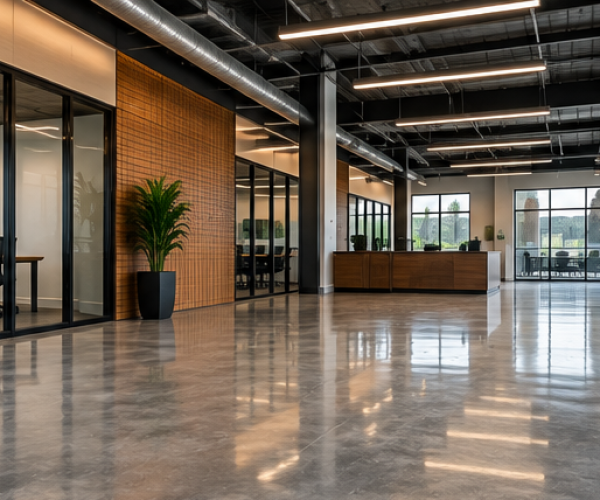
Polished Concrete Floors in Austin, TX
Polished concrete in Austin is your existing slab ground, hardened and refined into a finished floor. We work through diamond grit stages and a chemical densifier, adding nothing on top. Established 2012, more than 1,000 completed projects.
Request A FREE Quote
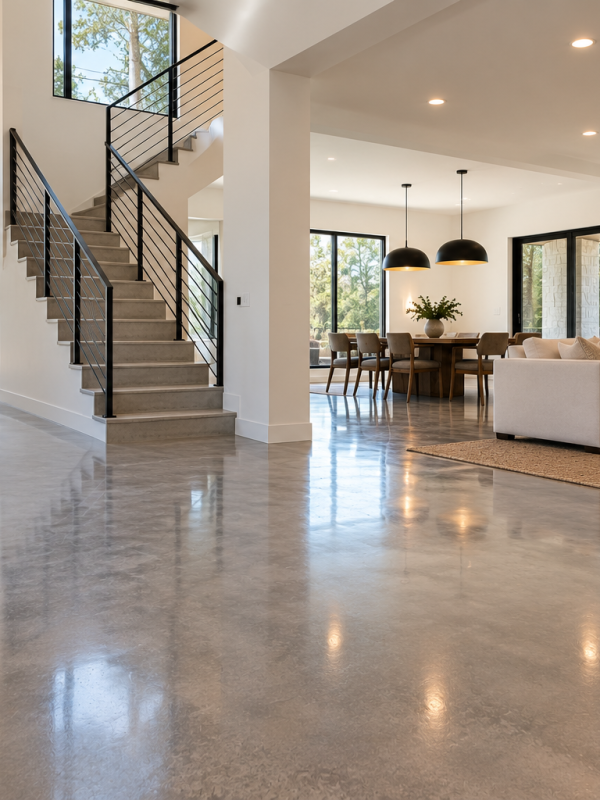
The word polished gets used loosely. Some floors sold as polished concrete are surface-coated, then buffed to a shine with a product applied over the top. That looks similar on handover day and behaves differently three years later. Every quote we write starts with someone looking at the slab, and it costs nothing. Mechanical polishing doesn’t add a layer at all. We grind the slab through progressively finer diamond abrasives and harden it chemically, then keep refining until the surface closes and starts holding light. The finish is the concrete itself.
It suits people who already own a slab and want it to become the floor. Homeowners renovating or building new, where polished concrete floors go into kitchens, living areas, garages. Businesses across retail, restaurants, offices, showrooms, where the floor takes daily punishment and still has to look presentable. Builders sequencing slab polishing into a construction programme.
We polish and nothing else. Not coatings, not overlays, not staining. That means the person quoting your floor has ground several hundred slabs rather than a handful between other jobs, and it’s why we’ll tell you early when a slab isn’t a good candidate.
How we polish a floor
Assessment. We look at the slab before quoting. Flatness, moisture movement, existing coatings, cracking, spalling, and how much aggregate sits near the surface. That last one decides how deep we can grind and what the finished floor will look like. We test slab moisture before committing to a finish level, because moisture moving up through concrete changes what’s achievable.
Preparation. Old adhesive, mastic, carpet glue and failed coatings come off mechanically rather than with solvents. Cracks and spalled areas get filled with color-matched material so they read as part of the floor instead of as patches. Control joints are filled where the floor needs a continuous surface.
Grinding. Coarse diamond tooling opens the surface, flattens high spots and takes off whatever was there before. This is the dusty stage, and we run vacuum extraction throughout. Adjoining rooms get sealed off, and we protect anything that stays in the space. Most residential jobs run a few days from first grind to final seal, and you generally can’t use the room during that window.
What we watch for at this stage is how evenly the slab opens. On a remodeled house it rarely opens evenly. One section starts showing aggregate quickly while the next stays cream with almost no stone in it, and the aggregate itself often looks different between the two. That tells us there was more than one pour, and it changes what we can promise about a uniform finish. It’s the single most common reason a finished floor doesn’t look the way someone pictured it, so we’d rather raise it while the grinder is still on the first pass than at handover.
Densifying. Lithium densifier goes down and reacts inside the concrete, hardening the slab from within. This is what makes a polished floor abrasion resistant, and it’s why the result isn’t a surface treatment.
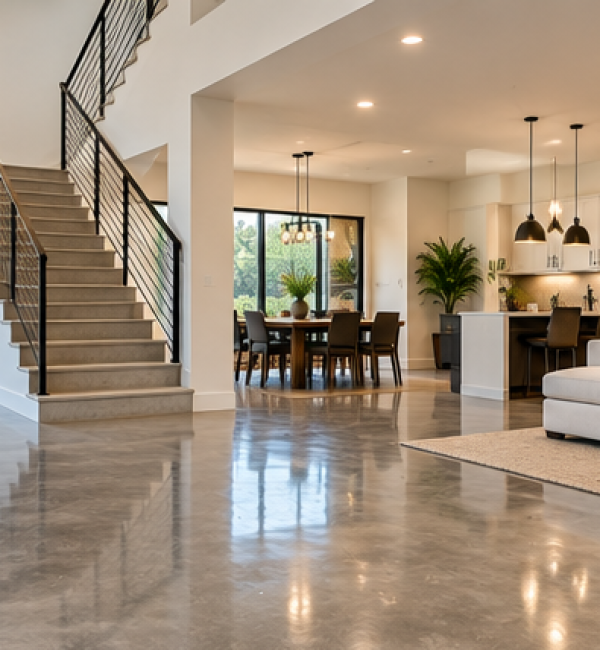
Polishing. Progressively finer grit stages refine the surface to the sheen you chose. Matte hides dust and footprints, so it suits workshop floors. Satin sits in the middle and works in most homes. High gloss carries light across an open floor.
Grinding depth is a separate decision from sheen. Stay shallow for a cream finish with little stone showing. Go deeper and more aggregate appears, up to a fully exposed stone surface. We bring samples so you’re choosing from something physical rather than a photograph on a screen.
Sealing. A penetrating sealer guards against water and oil staining while leaving the concrete look unchanged.
Why work with us
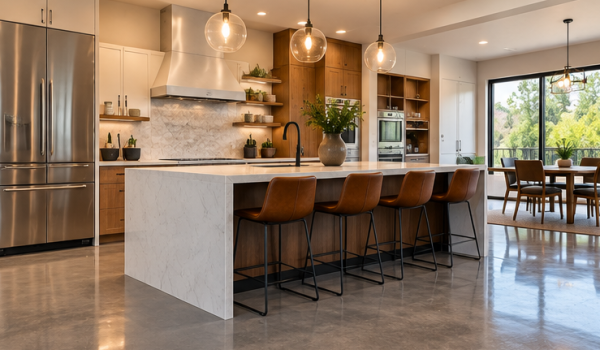
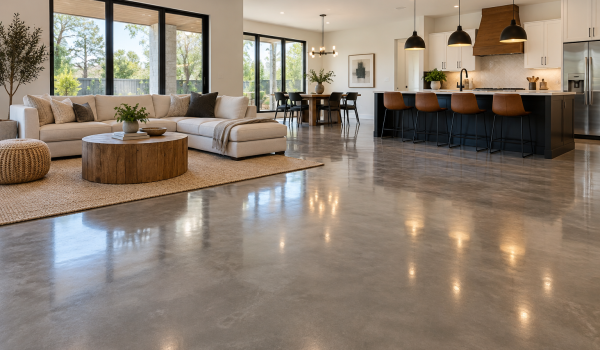
We have polished concrete in Austin since 2012, with more than 1,000 completed projects across Central Texas. Our Google reviews are public and we’d rather you read them than take our summary of them. The same goes for the work itself. Ask to see a floor we finished in a house like yours, and if there’s one nearby we’ll point you at it.
Fully insured. We hold no certifications we can’t show you, and we name no trade bodies we don’t belong to. That’s worth saying plainly, because plenty of sites in this trade claim both and can’t produce either when asked.
We assess before we quote, and estimates are free. Nobody prices polished concrete accurately over the phone. If polishing isn’t the right answer for your slab, you’ll hear that at the estimate rather than after the grinders are running.
Three things commonly rule a slab out. Moisture moving up through the concrete, which changes which sealer works and how the floor behaves later. A surface troweled so tightly that grinding through it takes far longer than expected. And structural cracking that is still moving, which is a different problem from surface damage and can’t be filled until the movement stops. None of the three is automatically fatal. All three change the timeline, the cost, or the finish that’s realistic.
None of the three is automatically fatal. All three change the timeline, the cost, or the finish that’s realistic. Those aren’t the only situations where we’d say no, and the rest are worth reading before you commit to a floor.
What we find under Austin floors
We work throughout Austin and the central neighborhoods, north to Round Rock and northwest to Cedar Park.
West to Lakeway, and out as far as Leander, Georgetown, Pflugerville and Hutto.
Polished concrete doesn’t hide the slab. It reveals it. That matters more here than people expect, because a lot of Austin housing stock has been worked on. Room additions, converted garages, enclosed patios, remodeled kitchens. Each one can mean a separate pour, and concrete poured twenty years apart doesn’t behave the same under a grinder.
What sits on top varies just as much. Pulling tile, carpet, vinyl or laminate usually means finding thinset, carpet adhesive, flooring glue, paint, old coatings, leveling compound, tack-strip holes and previous patches underneath. In a remodeled house the slab reads like a record of the work. A patch where a wall used to sit. A strip where plumbing was run. The seam where an addition met the original foundation, running through the middle of a room. Ghosting where tile sat for thirty years.
Some of that grinds out. Some of it stays visible after polishing. We’d rather tell you which is which before we start than after. And we can’t tell you what your slab holds from your address, because two houses on the same street routinely give us completely different floors.
Frequently asked questions
How much does polished concrete in Austin cost?
Cost depends on square footage, the condition of the slab, how much preparation it needs, and the finish level you choose. A slab needing adhesive removal and crack repair takes far longer than one that’s clean and flat, and preparation is where most of the labour goes. Estimates are free and include someone coming out to look at the floor first.
How long does a polished concrete floor last?
The floor lasts as long as the slab underneath it, because nothing was added that can fail separately. There’s no coating to peel and no recoating cycle. What changes is the sheen, which softens slowly in walkways where foot traffic drags grit across the surface. Burnishing restores it in a single visit without regrinding.
Can an old slab be polished?
Usually, and age matters far less than condition. We’ve polished slabs poured decades ago that finished well, and turned down newer ones that weren’t suitable. We check for moisture moving up through the concrete, spalling, and how tightly the slab was troweled. Any of those changes the timeline or the realistic result.
Is polished concrete slippery?
Less than most people expect. A polished surface has more traction than sealed tile or a coated floor, because the finish comes from the density of the concrete rather than a film sitting on top. Where extra traction is needed we adjust the finish. Wet areas, entryways and commercial kitchens get treated differently from a living room.
What is the difference between polished concrete and a coating?
A coating bonds to the top of your slab, and that bond is where it eventually fails. It’s why a coated garage floor lifts at the edges after a few winters. Polishing has no bond line because nothing is added. We grind and harden the concrete you already have. That’s the whole difference, and it’s why one needs renewing and the other doesn’t.
Do you work outside Austin?
Yes. Austin is our base and most of our work is here, but we cover most of Central Texas. Distance matters less than the size of the job, so a large commercial slab further out is often more workable than a small job nearby. If you’re outside the areas listed, ask and we’ll tell you honestly.
Get a free estimate
Based in Austin, Texas. Open Monday to Friday, 7:00 AM to 6:00 PM.
Call (512) 900-5938 or request an estimate and we’ll arrange a time to walk the slab with you.